
Key takeaways
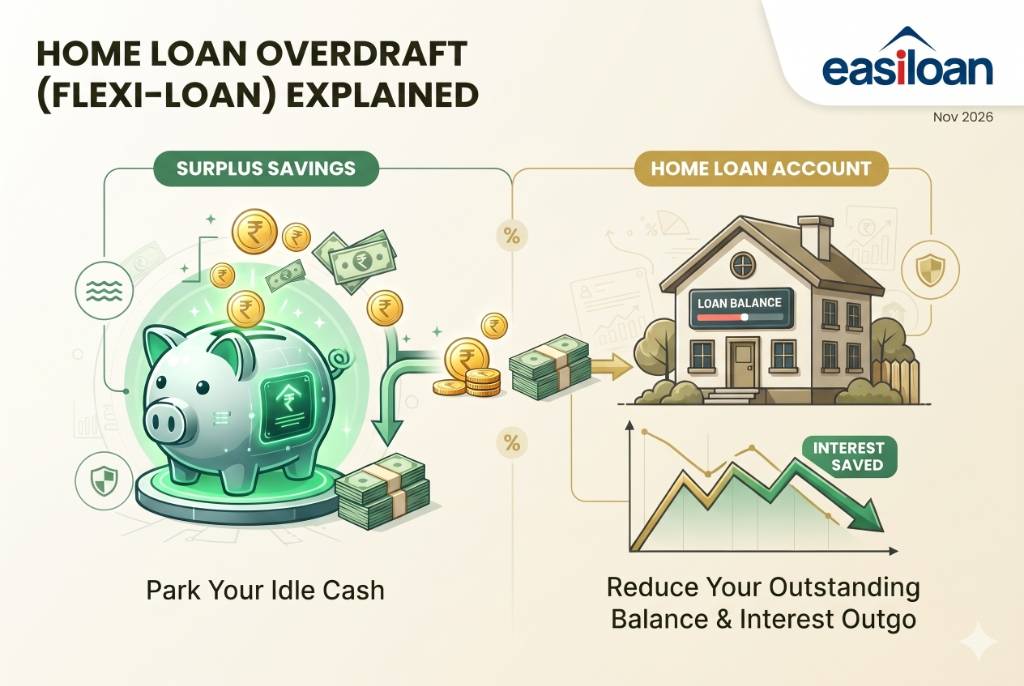
- An overdraft or flexi home loan lets you park surplus money against the loan and pay interest only on the net balance.
- Unlike a prepayment, parked money stays available to withdraw when needed.
- Illustrative: on a ₹50 lakh, 20-year loan at 8.75%, keeping ₹5 lakh parked from day one could close the loan about 4.4 years earlier with the same EMI.
- It suits people with lumpy or irregular surplus, such as self-employed borrowers and bonus earners, not those who rarely hold spare cash.
The idea in one line
With a standard loan, you owe the principal whether or not you hold cash. With an overdraft-style home loan, money you deposit into the linked account is netted against the loan balance for interest purposes. You pay interest only on what is left.
How it works in practice
- The lender sanctions a limit and registers the mortgage for it.
- You deposit surplus income, bonuses or business receipts into the loan account.
- Interest is calculated daily on the outstanding balance after netting the deposits.
- You can withdraw parked money when needed, within the available limit.
- Your EMI continues, so the extra interest saved shortens the tenure.
An illustrative saving
Take a ₹50 lakh loan, 20 years at 8.75%. The EMI is ₹44,186. Now suppose you keep ₹5 lakh parked against the loan from day one and continue paying the same EMI. Your effective balance is ₹45 lakh for interest purposes.
| Scenario | Effective balance | Approx. time to close |
|---|---|---|
| Standard loan, no parking | ₹50,00,000 | 20 years |
| ₹5 lakh parked throughout | ₹45,00,000 | 15.6 years |
The saving here is about 4.4 years of tenure, driven only by idle money that you were not using. Real outcomes depend on how steady your parked balance is. This model assumes a constant balance and an unchanged rate.
Rule of thumb: every ₹1 lakh parked for a full year saves roughly one year of interest on ₹1 lakh at your loan rate. At 8.75% that is about ₹8,750 a year, before any extra fee.
Who gains most
- Self-employed owners whose receipts arrive in lumps and sit idle before tax or supplier payments.
- Bonus or variable-pay earners who keep a cushion for months.
- People saving for a known expense (a school fee, a planned renovation) who would otherwise hold cash in a low-yield account.
What to check before choosing it
- One-time conversion or processing fee, and any annual charges.
- Rate difference versus the standard variant.
- Whether the limit reduces on a schedule and what happens at the end of tenure.
- How withdrawals are made (branch, cheque, net banking) and any restrictions.
- Whether the benefit is on the daily balance or only month-end.
Overdraft vs prepayment: which is better?
Since 1 January 2026, individual floating-rate loans for non-business purposes carry no prepayment charges under RBI rules, so part-prepayment is cost-free to do. The difference is flexibility. A prepayment cannot be pulled back out. If your surplus is steady and you will not need it, prepay. If it is irregular and you may need it, the overdraft's liquidity is the real benefit. Our guide on foreclosure vs prepayment covers the rules in more depth.
Frequently asked questions
How is a home loan overdraft different from a regular home loan?▾
A regular loan has a fixed principal schedule. An overdraft sets a limit, lets you deposit and withdraw, and charges interest on the day-wise outstanding after the balance you have parked.
Is it the same as prepayment?▾
No. A prepayment permanently reduces your principal. Parked money in an overdraft can be withdrawn, though the limit may shrink over time according to the lender's schedule.
Is the interest rate higher?▾
Some lenders price overdraft variants slightly higher or charge a one-time fee. Whether it pays off depends on how much surplus you keep and for how long.
Who should avoid it?▾
If you seldom hold surplus cash, the extra cost may outweigh the saving. In that case, regular part-prepayments on a standard floating-rate loan can be simpler and cheaper.
Do I still pay EMIs?▾
Typically yes. The EMI continues, and your parked balance reduces the interest portion, which in turn shortens the tenure.
Keep reading
This article is for general information and is lender-neutral. Interest rates, fees and policies change and vary by lender and borrower profile; figures marked illustrative are examples, not offers. Tax and legal points are not professional advice, so please confirm with a qualified professional. Credit is at the sole discretion of the lender, subject to appraisal, eligibility, rates, charges and terms.