
Managing a home loan effectively involves understanding the nuances of prepayment — settling your loan partially or entirely before the scheduled tenure. Prepayment can significantly reduce your interest burden and shorten the loan duration. However, it's essential to be aware of the associated rules, charges, and potential penalties to make informed decisions.
What is the Prepayment of a Home Loan?
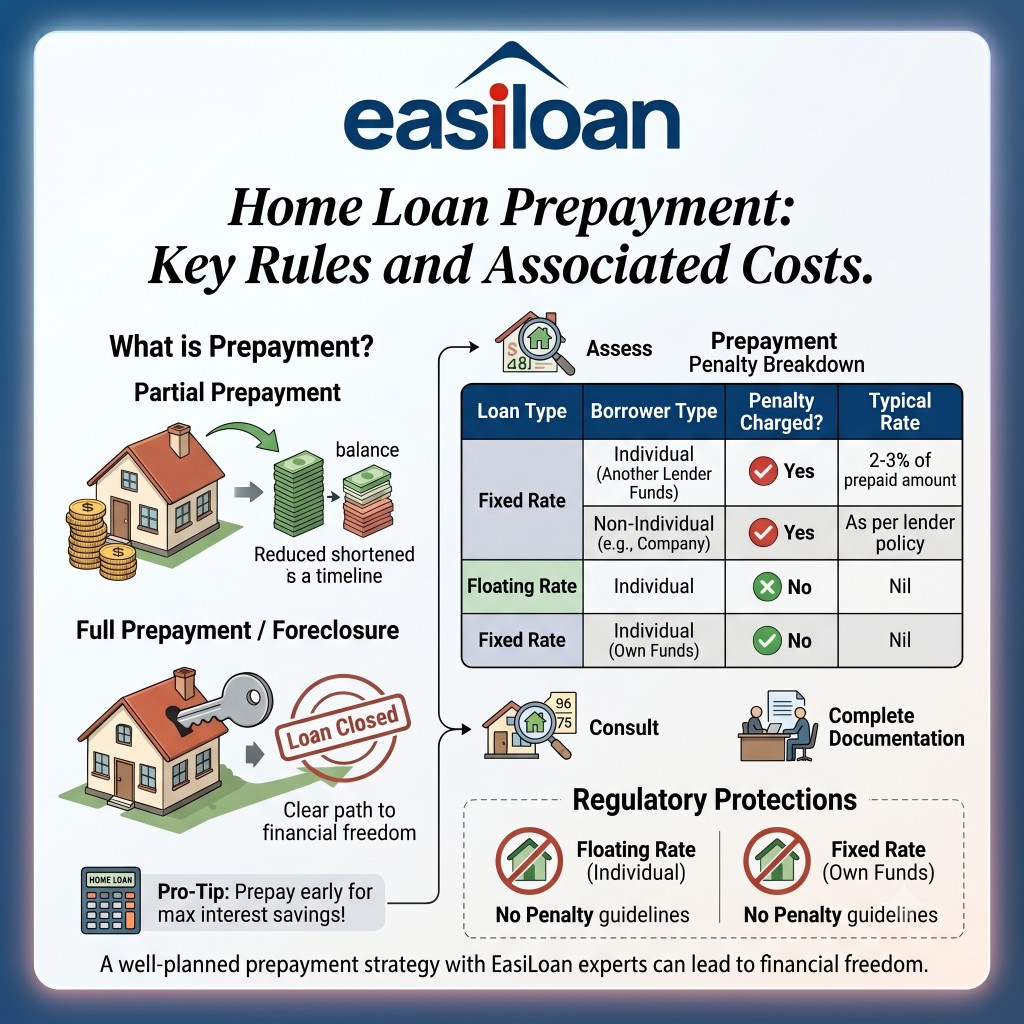
Prepayment refers to the act of paying off a portion or the entire outstanding principal amount of your home loan ahead of the agreed-upon schedule. This can be done in two ways:
Partial Prepayment
Paying an extra amount in addition to your regular EMIs to reduce the principal balance. This lowers future interest outgo and can shorten your loan tenure.
Full Prepayment (Foreclosure)
Settling the entire outstanding loan amount in one go, thereby closing the loan before its maturity — achieving complete financial freedom sooner.
💡 Prepaying early in the loan tenure leads to more significant interest savings, as interest payments are higher during the initial years. Always use a home loan EMI calculator to evaluate your options before making a prepayment decision.
Who is Eligible for Prepayment?
Eligibility for home loan prepayment depends on the lender's policies and the terms outlined in your loan agreement:
Individual Borrowers
- Most lenders allow prepayments with minimal restrictions
- Review your loan agreement for any lock-in periods
- Floating-rate borrowers enjoy zero prepayment penalties
Non-Individual Borrowers
- Companies and firms face different, stricter terms
- May be subject to prepayment penalties
- Especially applicable on fixed-rate loan structures
How Does the Prepayment Process Work?
When you decide to prepay your home loan, the process typically involves these steps:
Assessment
Determine the amount you wish to prepay and assess its impact on your loan tenure and total interest savings using an EMI calculator.
Consultation
Contact your lender to inform them of your intent to prepay and understand any associated charges or procedures.
Documentation
Complete any required documentation as per the lender's policies before initiating the payment.
Payment
Make the prepayment through the accepted modes of payment — NEFT, RTGS, cheque, or online portal.
Confirmation
Obtain a written confirmation from the lender acknowledging the prepayment receipt and the revised loan terms or closure certificate.
When Can Banks and NBFCs Charge Prepayment Fees?
Financial institutions may levy prepayment penalties under specific conditions:
| Loan Type | Borrower Type | Penalty Charged? | Typical Rate |
|---|---|---|---|
| Fixed Rate | Individual (funds from another lender) | Yes | 2% – 3% of prepaid amount |
| Fixed Rate | Non-Individual (companies/firms) | Yes | As per lender policy |
| Floating Rate | Individual | No Penalty | Nil |
| Fixed Rate | Individual (own funds) | No Penalty (HFCs) | Nil |
When Are Lenders Not Allowed to Charge Prepayment Fees?
Regulatory guidelines protect borrowers from excessive prepayment penalties. Banks and NBFCs are prohibited from charging prepayment fees in these scenarios:
Floating Rate Home Loans
- No prepayment penalties for individual borrowers
- Applies to both partial and full prepayments
- Mandated by RBI and NHB guidelines
Fixed Rate — Own Funds
- No penalty if prepaid using personal/own funds
- Applicable for HFCs specifically
- Does not apply if funds are borrowed from another lender
Bottom Line
Prepaying your home loan can be a significant financial move, offering benefits like reduced interest costs and shorter loan tenures. However, it's imperative to be well-versed with your lender's prepayment rules, potential charges, and regulatory guidelines to avoid unnecessary expenses.
Floating-rate borrowers enjoy the advantage of zero prepayment penalties, making it a highly beneficial option to clear debts faster. Those with fixed-rate loans should verify whether prepayment penalties apply before proceeding.
A well-planned prepayment strategy with EasiLoan experts can lead to financial freedom, lower overall debt, and better financial management.
Frequently Asked Questions
Can I prepay my home loan anytime?▾
Yes, in most cases. However, some lenders impose a lock-in period during which prepayment is not allowed. Always review your loan agreement for specific conditions before attempting a prepayment.
Is there a minimum amount for partial prepayment?▾
Many lenders set a minimum prepayment amount, typically equivalent to one or more EMIs (e.g., 3x or 6x your monthly instalment). Check your lender's policy for the exact threshold applicable to your loan.
Should I reduce EMI or tenure after prepayment?▾
It depends on your financial goals. Reducing the tenure saves more on total interest and helps you become debt-free sooner. Reducing the EMI improves monthly cash flow. If you have surplus savings, reducing tenure is generally the better choice mathematically.
Are there tax implications when prepaying a home loan?▾
Yes. Prepaying a home loan reduces the outstanding principal and future interest payments. This may lower the interest deduction available under Section 24(b) and principal repayment benefit under Section 80C. Consult a tax advisor to assess the impact on your annual tax planning.
What documents do I need after full prepayment?▾
After full foreclosure, ensure you collect: (1) No Dues Certificate / NOC from the lender, (2) Original property documents, (3) CERSAI charge removal confirmation, and (4) Updated Encumbrance Certificate. These are critical for future property transactions.
Disclaimer: This content is for educational and informational purposes only and does not constitute financial, legal, or investment advice. Prepayment rules, penalty charges, and regulatory requirements are subject to change. Please consult your lender or a qualified advisor for the most current information. Easiloan accepts no liability for decisions made based on this content.
Plan Your Prepayment
Speak with an EasiLoan expert to find the best prepayment strategy tailored to your loan profile.
Talk to an Expert →