
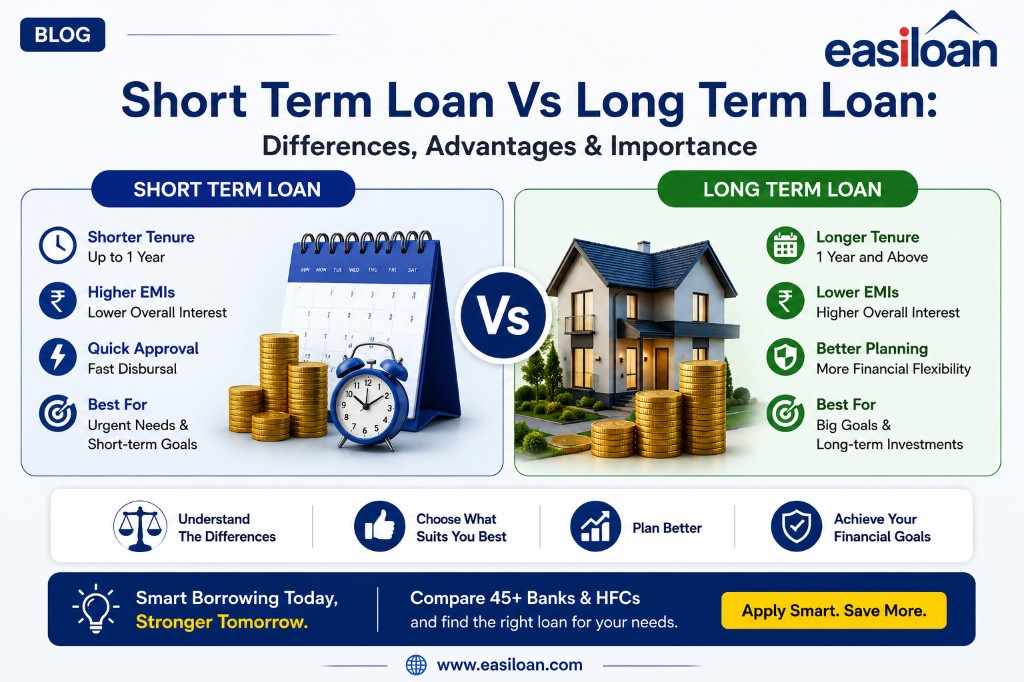
Choosing a loan tenure isn't just about how long you'll be repaying — it shapes your EMI, your total interest outgo, and how much financial flexibility you have along the way.
Whether you're financing a business need or a home purchase, loans broadly fall into two categories: short term and long term. Each comes with its own tradeoffs around interest rates, collateral, EMI size, and how quickly funds are disbursed. Here's a complete breakdown of both, so you can match the tenure to your actual financial situation.
Not sure which tenure fits you?
Compare EMIs for short and long tenures, then check your real eligibility across lenders with EasiLoan.
What Is a Short Term Loan?
A short term loan is a financing option designed to meet immediate financial needs — typically operational costs, working capital requirements, or expansion plans for a business. The tenure usually runs three to five years, and the borrower repays both principal and interest before the term ends.
Advantages
- Quick access to funds — often approved within days, sometimes hours, versus weeks for traditional loans
- Customisable terms — flexibility to tailor the loan length and repayment schedule
- No collateral required — relies mainly on creditworthiness rather than pledged assets
Disadvantages
- Higher interest rates — lenders treat shorter tenures as riskier
- Shorter repayment window — can strain cash flow for an early-stage business with limited revenue
What Is a Long Term Loan?
Long term loans suit borrowers who need an extended repayment period that aligns with their financial capacity. They're commonly used for personal needs like weddings and medical emergencies, debt consolidation, and larger investments like homes or businesses. Tenure can span from 5 to 25 years, unlocking access to larger loan amounts with comparatively lower monthly instalments.
Advantages
- Lower interest rates — the extended repayment window benefits the lender through sustained interest earnings
- Simpler eligibility criteria — comparable to personal loans, making the process easier
- Builds credit over time — timely EMIs strengthen your credit profile, and some loans like home loans offer tax benefits
Disadvantages
- Impacts monthly cash flow and usually requires collateral, putting assets or your home at risk on default
- Credit score risk — missed payments can significantly hurt future loan approvals, so these are best reserved for genuine long-term needs
Where Long Term Loans Make Sense
Education loans are a good example — students financing courses like engineering or medicine can repay over up to 30 years. Home loans work similarly for anyone needing a substantial amount with a longer repayment runway, and car loans or personal loans can also be structured over extended periods to keep instalments manageable.
Short Term Loan vs Long Term Loan: Key Differences
| Aspect | Long Term Loan | Short Term Loan |
|---|---|---|
| Tenure | Beyond 5 years, up to 30 years | Typically 5 years or below |
| Collateral | Usually required — most home loans are secured against the property | Not always required; when needed, the asset can be released quickly |
| Interest rate | Lower, due to smaller payments spread over more years | Higher, to compensate lenders for shorter-term risk |
| EMI | Usually lower | Higher, to recover the amount faster |
| Disbursement | Slower — lenders evaluate creditworthiness and repayment capacity thoroughly | Faster — smaller amounts, minimal documentation |
Factors to Consider When Choosing Between the Two
Loan amountLong term loans generally support higher amounts with longer tenure, while short term loans tend to involve smaller amounts with faster repayment.
Interest ratesShort term loans typically carry higher rates due to the compressed repayment window; long term loans benefit from lower risk perception over a longer period.
DurationShort term loans run roughly 1–5 years, while long term loans can extend from 10–20 years or more, spreading repayment further.
Monthly incomeYour EMI should stay within 30-35% of your monthly income — a long term loan lowers this burden, while a short term loan raises it.
AgeBorrowers in their 20s with rising income potential are well-positioned for long term loans. Those in their late 40s or 50s often have to opt for shorter tenures, since most lenders cap repayment near retirement age.
Objective of purchaseBuying with an investment mindset favours a short term loan; buying for self-use favours a longer tenure to keep EMIs low and reduce default risk.
Choosing Between Short Term and Long Term Loans
The right choice ultimately comes down to your repayment ability and financial priorities. If you'd rather keep monthly instalments low and avoid overburdening your cash flow, a long term loan is the better fit. If you want quick disbursal and can comfortably absorb a higher interest rate, a short term loan gets the job done faster.
Age matters too — lenders often view applicants nearing retirement as higher risk for long tenures, which can limit eligibility for those in their 40s and 50s.
Since a home loan is a secured loan, the property itself acts as collateral — defaulting means the lender can seize it to recover their loss. Choosing a tenure that keeps your EMI genuinely affordable is the single biggest factor in avoiding that outcome. An online EMI calculator is a quick way to see exactly what you'd be signing up for before you apply.
Frequently Asked Questions
What is the main difference between a short term loan and a long term loan?+
The main difference is repayment tenure. Short term loans are usually repaid within five years, while long term loans can extend up to 25-30 years, resulting in lower EMIs but more total interest paid.
Is a long term loan cheaper than a short term loan?+
Long term loans usually carry lower interest rates and lower monthly EMIs, but because they're repaid over more years, the total interest paid over the loan's life is typically higher than a short term loan.
Does age affect whether I should choose a short or long term home loan?+
Yes. Younger borrowers with rising income potential are generally better suited to long term loans, while those closer to retirement age often have to opt for shorter tenures since most lenders cap repayment at or near retirement age.
Do short term loans require collateral?+
Not always. Short term loans often rely on the borrower's creditworthiness rather than collateral, whereas most long term loans like home loans are secured, with the property itself acting as collateral.
How much of my income should go towards EMIs?+
As a general guideline, EMIs should not exceed 30-35% of your monthly income, to keep repayment manageable alongside your other expenses.
Conclusion
Choosing the right loan tenure comes down to your monthly income, age, interest rate expectations, and the objective behind the purchase. A long term loan lowers your EMI but increases total interest paid; a short term loan does the opposite. Assess your needs and financial situation honestly before deciding — and run the numbers before you commit.
See your real EMI before you decide
Compare short and long tenure home loan offers from multiple lenders in one place, and check your actual eligibility with EasiLoan.
Check Your Eligibility