
Key takeaways
- Lenders generally lend a percentage of the lower of the agreement price and their valuer's assessed value.
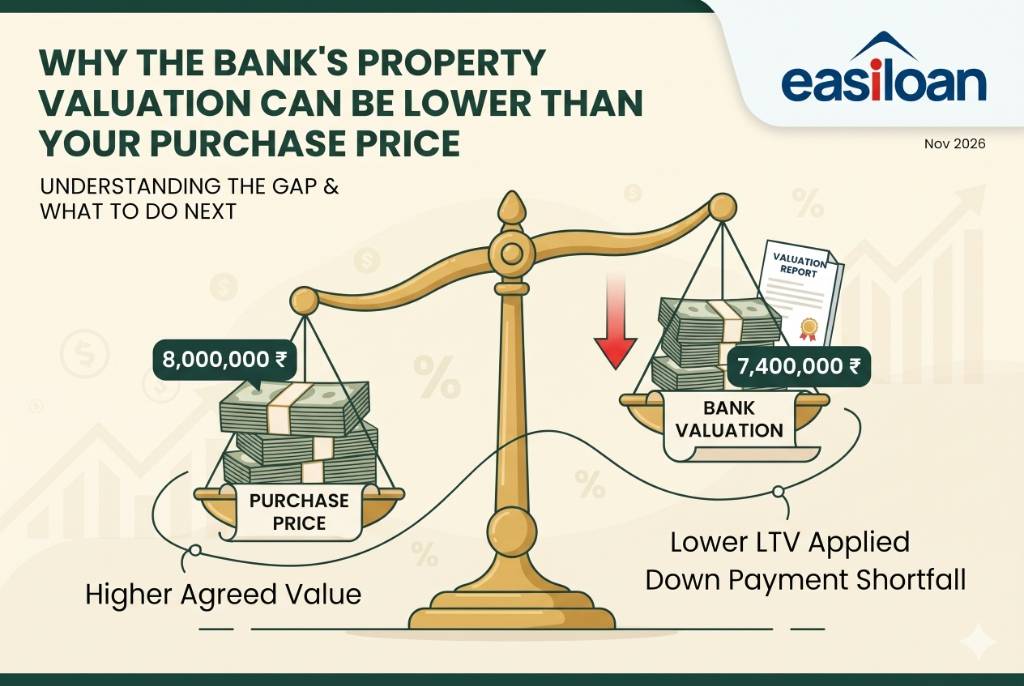
- Illustrative: on an ₹80 lakh price valued at ₹74 lakh with an 80% LTV, the loan falls from ₹64,00,000 to ₹59,20,000, so you must find about ₹4,80,000 more.
- Valuation reflects the lender's view of realisable value, not what you or the seller agreed.
- You can ask for the report, share comparable sales and negotiate the price before you sign.
Price is what you agreed; valuation is what the lender can rely on
The agreement price is a negotiation between you and the seller. The valuation is the lender's own assessment of what it could realise from the property if it ever had to enforce its security. That second number is deliberately cautious, which is why it can come in under the price.
How valuers arrive at a number
- Recent registered transactions of comparable properties nearby.
- Location, connectivity and the micro-market's liquidity.
- Age, condition and construction quality.
- Legal and approval status of the building.
- Builder-linked pricing premiums, which valuers often discount.
What it does to your loan amount
Lenders apply a loan-to-value (LTV) ratio to the lower of price and valuation. Our guide to the RBI LTV framework explains why the ratio matters. Here is a simplified example at an assumed 80% LTV.
| Feature | On agreed price | On valuation |
|---|---|---|
| Value used | ₹80,00,000 | ₹74,00,000 |
| Loan at 80% LTV | ₹64,00,000 | ₹59,20,000 |
| Amount you fund yourself | ₹16,00,000 | ₹20,80,000 |
The extra cash you must arrange is ₹4,80,000. It is easy to miss this when the earlier budget assumed the full LTV on price.
Plan for it: keep a buffer in your down payment plan, especially for resale flats and for premium-priced projects.
What you can do
- Ask for the valuation basis. A short summary of comparables helps you see why.
- Share evidence of nearby recent sales if they are higher.
- Renegotiate the price with the seller or builder if the gap is genuine.
- Raise the down payment if the property is otherwise right for you.
- Compare lenders. Valuers differ, and a second lender may value differently.
What not to do
- Do not sign an agreement at a price you cannot support without the full LTV.
- Do not accept "adjusting" the agreement value to match valuation without understanding the stamp duty and tax consequences.
- Do not use informal cash components. They create legal and tax risk.
Before you sign
If you are early in the process, ask for an indicative valuation or a pre-approval first. It is also worth reviewing the seller's papers in parallel, as outlined in our resale checklist.
Frequently asked questions
Why is the bank's valuation lower than my purchase price?▾
The valuer estimates what the property could fetch in the market on a conservative basis, using comparable sales, location, age, construction quality and legal status. This can be lower than a negotiated or developer-quoted price.
Does the bank lend on valuation or price?▾
Generally on whichever is lower, subject to the loan-to-value limit. The exact rule is in the lender's policy and the RBI framework.
Can I challenge the valuation?▾
You can ask for the basis, provide comparable transactions and request a review. Lenders may accept a revision if the evidence is strong, but they are not obliged to.
Does stamp duty count in the property value?▾
Usually the loan is based on the property value, not on registration or ancillary costs. Ask your lender how it treats them for your case.
What if the shortfall is large?▾
Renegotiate the price, increase your down payment, add a co-applicant if it helps eligibility, or reconsider the property.
Keep reading
This article is for general information and is lender-neutral. Interest rates, fees and policies change and vary by lender and borrower profile; figures marked illustrative are examples, not offers. Tax and legal points are not professional advice, so please confirm with a qualified professional. Credit is at the sole discretion of the lender, subject to appraisal, eligibility, rates, charges and terms.