
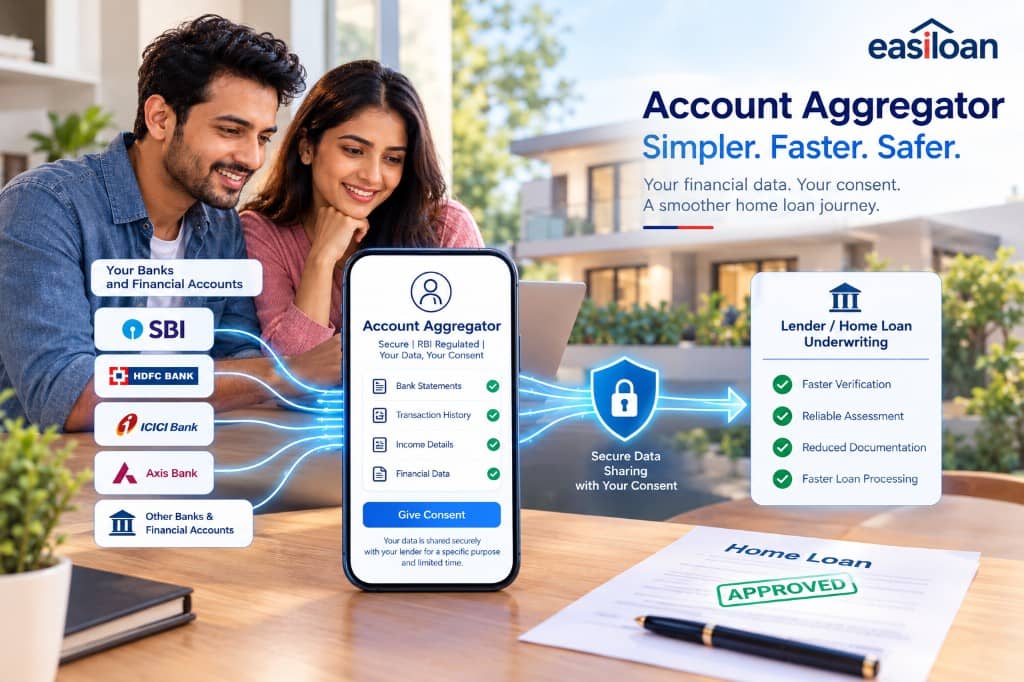
One of the less-visible but increasingly important shifts in Indian home loan processing is how lenders access your financial data in the first place.
What the AA framework actually is
An Account Aggregator is an RBI-regulated entity that, with your explicit digital consent, securely pulls your financial data — bank statements, in particular — directly from your bank and shares it with a lender in a structured, verifiable digital format. This replaces the older process of manually downloading, printing, or emailing PDF bank statements, which lenders then had to review and verify by hand, often introducing delay and occasional data-entry error.
Recent industry commentary tied to the Tier-2/3 housing finance growth trend specifically flags Account Aggregator-led underwriting as one of several structural forces shaping the next phase of housing finance in India, alongside affordable housing demand and growing digital sourcing.
Why it matters for borrowers
For the borrower, the practical benefit is speed and reduced friction: instead of gathering and submitting months of bank statements manually, you can consent once, digitally, to share verified data directly from your bank to the lender's underwriting system. For the lender, it means faster, more reliable income and cash-flow assessment — valuable for borrowers whose income doesn't fit neatly into a standard salaried-employee profile.
92%
Housing-finance applications processed digitally (2024), up from 60% in 2020
33% → 50%
HFC share of Tier-3+ disbursements, FY21 to H1 FY26
RBI-regulated
AA framework operates under formal central bank oversight
Example
A self-employed borrower in a Tier-2 city, whose income historically required extensive manual documentation — often a slower, more uncertain process than for salaried applicants — can, through AA-based consent, allow a lender to pull verified bank transaction data directly, potentially speeding up both the initial eligibility assessment and the final underwriting decision, since the lender works with system-verified data rather than manually submitted documents.
Given it's cited as one of the structural forces behind faster-growing, digitally-native lending in smaller cities, continued expansion of AA-based underwriting — particularly among HFCs serving Tier-2/3 markets — appears likely, though the pace and scope of individual lender adoption isn't uniform.
What should homebuyers do?
- Ask your lender whether they support Account Aggregator-based document submission — it can meaningfully speed up your application.
- Only consent to data-sharing through official, RBI-regulated AA apps and lender-integrated flows — never through unofficial channels claiming to offer this.
- Understand that consent is typically time-bound and purpose-specific, not indefinite access.
- If you're self-employed or have variable income, specifically ask about AA-based underwriting — often most valuable for profiles that traditionally faced slower manual review.
- Keep your own copies of statements and documents regardless of digital consent-sharing.
Exploring faster-processing lenders?
Compare offers from both traditional banks and digitally-forward HFCs.
Try the EMI CalculatorFrequently Asked Questions
Is the Account Aggregator framework safe to use?▾
It operates under RBI regulation specifically for secure, consent-based financial data sharing, with time-bound and purpose-specific data flows — but only use official, lender-integrated AA channels.
Do I have to use Account Aggregator-based data sharing, or can I still submit documents manually?▾
Most lenders still accept traditional manual document submission alongside AA-based options — generally offered as a faster alternative, not a mandatory replacement.
Does using AA-based underwriting affect my loan eligibility or interest rate?▾
Not directly — it affects how quickly and efficiently your existing financial data is verified, not the underlying eligibility criteria or rate you'd otherwise qualify for.
Which lenders currently support this?▾
Adoption varies — many digitally-forward HFCs and banks have integrated AA-based flows, but it's not universal across all lenders yet.
Can I revoke my consent after sharing data through an AA?▾
Yes — AA-based consent is designed to be time-bound and revocable, though the specific mechanics for revocation depend on the AA app and lender involved.
Sources
- SocialNews.XYZ, "Tier 2, 3 cities to drive next wave of India's home-loan growth as digital lending soars," 2 September 2026
- Home First India, "Trends in Affordable Housing Financing in India: 2025-26 Analysis," 2026
Related Reading
Information in this article reflects publicly available data and reporting as of the "as of" date stated above. Figures tied to a live or proposed RBI decision may change once a final announcement is made — always confirm the latest position with your lender. This is general information, not financial advice. EMI figures are indicative estimates. Home loan rates, spreads, fees and eligibility vary by lender and are subject to credit appraisal.