
Key takeaways
- A top-up is an additional loan on top of your existing home loan, secured against the same property.
- Because it is secured, its rate is usually well below a personal loan, though often a little above your base home loan rate.
- On an illustrative ₹5 lakh need, a 10-year top-up at 9% costs about ₹2,60,055 in interest; a 5-year personal loan at 14% costs about ₹1,98,048, though the EMI on the shorter loan is higher.
- Lenders usually check repayment track record, remaining tenure, property value and your current FOIR before approving.
What a top-up home loan actually is
A top-up home loan is extra borrowing on a home loan you are already repaying. The lender uses the same property as security, so there is no new collateral to arrange. In practice, it often arrives as a separate loan account with its own rate and tenure, or as an increase in the original sanction.
This makes it a middle path between two extremes: the low-cost, long-tenure home loan you took to buy the house, and expensive, quickly approved unsecured credit.
Who can get one, and what lenders look at
- Repayment record: most lenders want a period of regular EMIs on the existing loan first, and no recent delays.
- Remaining tenure and age: a top-up usually cannot run beyond the lender's maximum age or the existing loan's end date by much, so a short remaining tenure limits the amount.
- Property value: the combined loan generally cannot exceed the lender's permitted share of the current property value (the LTV framework applies).
- Income and obligations: your total EMIs are checked against income through FOIR.
- Credit score: a healthy score improves both approval odds and pricing.
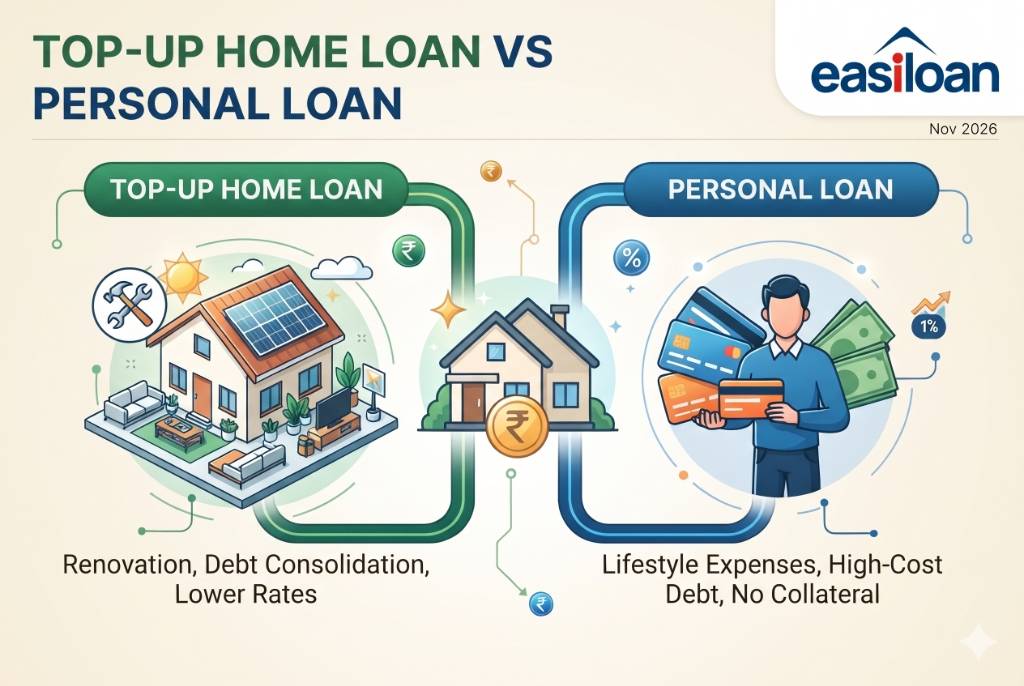
Top-up vs personal loan: a worked comparison
Suppose you need ₹5 lakh. The rates below are illustrative only; your actual offer depends on your lender and profile.
| Feature | Top-up home loan | Personal loan |
|---|---|---|
| Illustrative rate | 9.0% p.a. | 14.0% p.a. |
| Tenure | 10 years | 5 years |
| Monthly EMI | ₹6,334 | ₹11,634 |
| Total interest | ₹2,60,055 | ₹1,98,048 |
| Security | Your property | None |
Notice that the top-up has the lower interest bill even with a longer tenure, but the personal loan clears faster. If you can afford the shorter personal loan, the comparison narrows. A fair comparison is the same tenure on both, which usually still favours the secured loan.
The trade-off to remember: a top-up puts your home behind another loan. Use it for needs that justify that risk, not for lifestyle spending that you could fund another way.
Good uses and poor uses
Reasonable uses
- Renovation or repair that adds comfort or value (see our renovation financing guide)
- Consolidating costly short-term debt into one cheaper EMI
- Planned education or medical expenses
Uses to think twice about
- Investing the borrowed money in volatile assets
- Funding a consumption purchase you can delay
- Stretching your tenure for a small amount you could prepay from savings
Tax angle in brief
Interest paid on money used to acquire, construct, repair or renovate the property can be eligible for an interest deduction on house property, within the caps and conditions of the law and the regime you choose. Interest on top-up money used for other purposes generally cannot. Keep records of how the money was spent, and read our tax benefits guide for the wider picture.
Before you accept the offer
- Ask for the rate, the benchmark it is linked to and the reset terms.
- Check processing fees and any charges on the top-up account.
- Confirm whether the top-up carries its own tenure or follows the main loan.
- Run the new combined EMI through the calculator to confirm affordability.
- Compare against a balance transfer with top-up if your current rate is high.
Frequently asked questions
What is a top-up home loan?▾
It is an additional loan sanctioned on an existing home loan, secured against the same property. The lender usually gives it after you have repaid for a minimum period with a clean record.
Is a top-up loan cheaper than a personal loan?▾
Usually yes, because it is secured by property. The exact gap depends on the lender and your profile, so compare the all-in cost including fees rather than only the headline rate.
Can I use a top-up for anything?▾
Many lenders allow broad end uses such as renovation, education or medical needs, but some restrict speculative uses. Your sanction letter states the permitted purposes.
Does a top-up get tax benefits?▾
Possibly. Interest on money used to buy, build, repair or renovate the house may qualify for a house-property interest deduction, subject to caps and the tax regime you choose. Money used for other purposes generally does not. Confirm with a tax professional.
Can I get a top-up through a balance transfer?▾
Yes. When you move a loan to another lender, a top-up is often offered alongside the transfer, so compare the combined rate and fees.
This article is for general information and is lender-neutral. Interest rates, fees and policies change and vary by lender and borrower profile; figures marked illustrative are examples, not offers. Tax and legal points are not professional advice, so please confirm with a qualified professional. Credit is at the sole discretion of the lender, subject to appraisal, eligibility, rates, charges and terms.