
Geopolitics & Home Finance
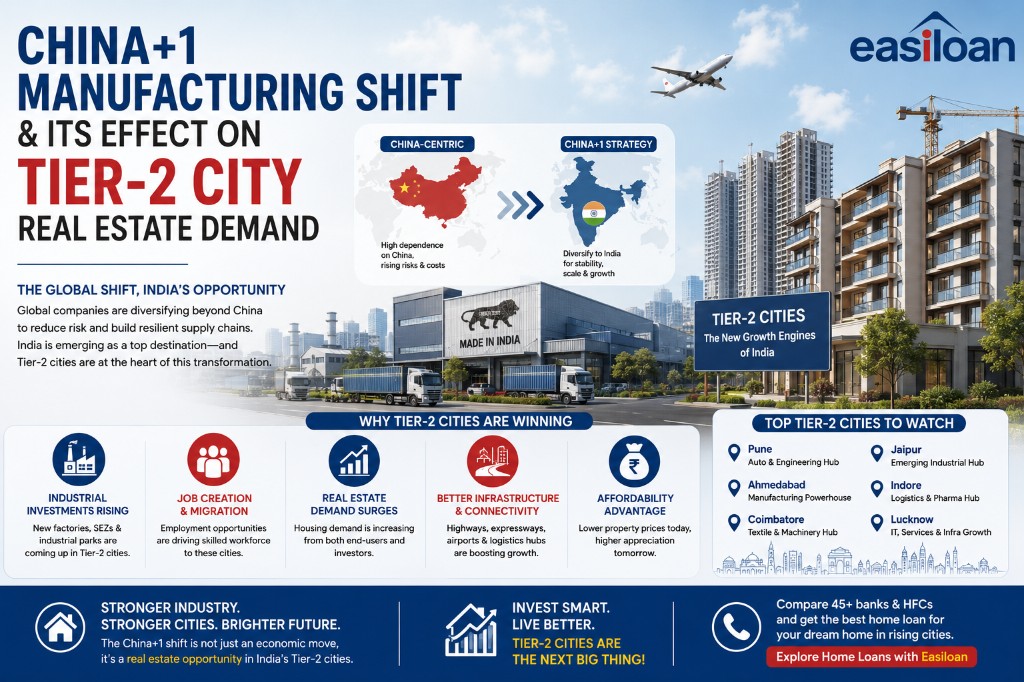
Since global manufacturers began actively diversifying away from a China-only supply chain, India has been one of the biggest beneficiaries, and the effects are visible well beyond the usual metro skylines. A growing share of that momentum is landing in tier-2 cities: places building industrial parks, warehousing hubs, and, in turn, entirely new residential demand.
72.5M sq ft
2025 logistics space absorption, record high
44%
Developer land acquisition in tier-2/3 cities (2024)
25–100%
Projected tier-2/3 land price rise over 2-4 years
Why manufacturers are choosing India
The China+1 approach means global manufacturers add a second production base outside China to reduce concentration risk, whether from tariffs, trade tensions, or supply disruptions. India has captured a meaningful share of this diversification, helped by production-linked incentive schemes, a large domestic market, and improving logistics infrastructure. Manufacturing accounted for a substantial share of industrial and logistics leasing through 2025 into 2026, with record absorption driven partly by this structural shift.
Where the housing demand is landing
Nagpur
Central logistics hub with metro expansion; land values reportedly up sharply on industrial and warehousing momentum.
Indore
Diversified industrial base attracting steady residential investment alongside infrastructure upgrades.
Coimbatore
Established industrial and educational center with a broad economic base supporting rental demand.
Lucknow & Jaipur
Benefiting from expressway connectivity, new airports, and expanding job clusters.
The chain from factory to home loan
- Factories create jobs. New manufacturing and logistics facilities bring direct employment and a supporting ecosystem of vendors and services.
- Jobs create housing demand. Workers and their families need homes near new industrial clusters, driving demand for both rental and owned housing.
- Demand pulls in developers. Rising land acquisition in these cities, government data shows tier-2/3 markets already capturing a large share of developer land buys, signals where new supply will concentrate next.
- Financing follows the market. As transaction volumes grow in a city, lenders typically expand their footprint and product options there too.
The takeaway: A factory announcement in a tier-2 city today is often a leading indicator of a housing demand cycle two to three years out, not an immediate one. Early movers accept more uncertainty for potentially better entry pricing.
What to weigh before buying in an emerging city
Not every location benefiting from headline manufacturing announcements will see proportional real estate appreciation. Government infrastructure timelines can slip, and industrial investment doesn't always translate one-to-one into housing demand on the promised schedule. Evaluating a specific micro-market's actual job creation, connectivity progress, and existing housing supply overhang is more useful than following city-level headlines alone.
How EasiLoan helps
Whether you're financing a home in an established metro or an emerging industrial city, EasiLoan compares live offers from multiple lenders so you understand your actual eligibility, interest rate, and loan-to-value terms for that specific location, without having to visit every bank separately.
Related Reading
Frequently Asked Questions
What is the China+1 strategy?▾
China+1 refers to global manufacturers diversifying production away from sole reliance on China by adding a second manufacturing base, often in countries like India, Vietnam, or Mexico, to reduce supply chain and geopolitical risk.
Which Indian tier-2 cities are seeing the most real estate growth from this shift?▾
Cities such as Nagpur, Indore, Coimbatore, Lucknow, and Jaipur have seen notable land acquisition and infrastructure investment tied to logistics, warehousing, and manufacturing expansion.
Is it a good idea to buy a home loan-funded property in an emerging tier-2 city?▾
Emerging cities can offer more affordable entry points and rising rental yields, but they also carry more uncertainty than established metros. It's worth evaluating the specific city's job creation trends, infrastructure timelines, and your own long-term plans before committing.
Do home loan interest rates differ between metro and tier-2 cities?▾
Base interest rates are generally similar across locations for a given lender and borrower profile, though processing terms, property valuation, and loan-to-value ratios can vary by micro-market. Comparing offers across lenders for your specific city is the most reliable way to know your actual terms.
Disclaimer: EasiLoan is a home loan advisory and comparison platform and is not a direct lender. Market figures and city trends cited above are indicative, sourced from public industry reports as of mid-2026, and subject to change. Real estate investments carry market risk; please conduct independent due diligence and verify current rates with your chosen lender before making a borrowing decision. This article does not constitute investment advice.
Invest smart. Live better.
Compare 45+ banks & HFCs and explore home loans with EasiLoan.
Check My Eligibility →