
● RBI Policy & Home Finance · 2026
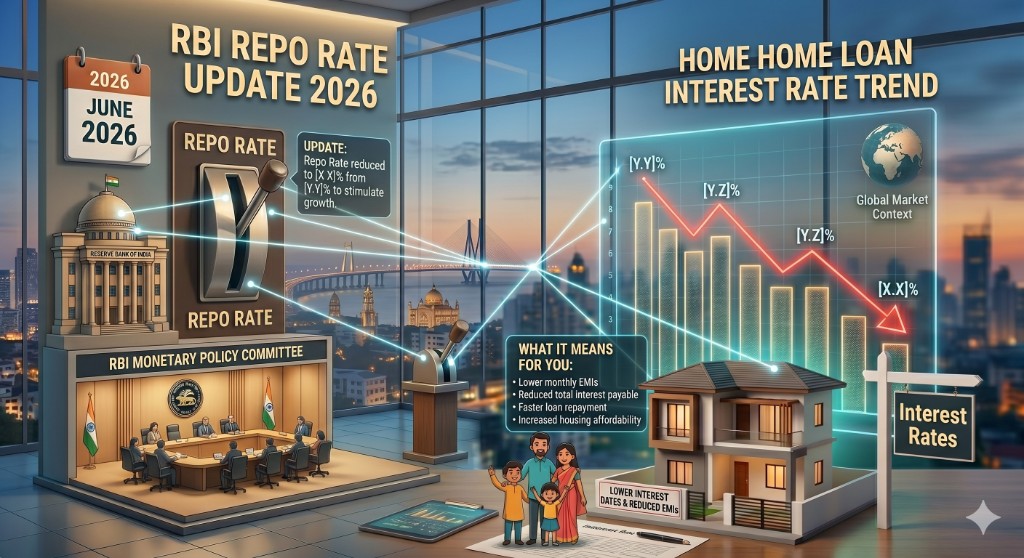
The RBI's repo rate is the single most influential number for home loan borrowers in India. Whether you're planning to buy a home or already repaying a loan, here's a clear breakdown of what the latest 2026 update means for your EMI, eligibility, and long-term interest costs.
What Is the RBI Repo Rate?
The Repo Rate is the interest rate at which the Reserve Bank of India lends short-term funds to commercial banks. It acts as the foundational benchmark for lending rates across India's entire banking system.
When the RBI adjusts this rate, banks adjust the cost at which they lend — and since most home loans today are linked to the External Benchmark Lending Rate (EBLR), which tracks the repo rate, changes flow through to borrowers relatively quickly.
RBI Sets Repo Rate
Banks Adjust EBLR
Home Loan Rate Changes
Your EMI Moves
How Does the Repo Rate Affect Your Home Loan?
The direction of the rate change determines whether borrowers benefit or face additional costs. Here's what each scenario typically means:
When RBI Cuts the Repo Rate
- Banks' borrowing costs fall
- Home loan interest rates reduce
- Monthly EMI decreases
- Loan eligibility improves
- Long-term interest burden drops
When RBI Raises the Repo Rate
- Banks' borrowing costs rise
- Home loan interest rates increase
- Monthly EMI goes up
- Loan eligibility may reduce
- Total repayment cost rises
Impact on Existing Borrowers
Floating Rate Home Loans
If your home loan is on a floating rate (which most EBLR-linked loans are), your EMI or loan tenure will directly reflect any repo rate change. A rate cut means your bank must pass on the benefit within a defined reset period — typically within 3 months.
- EMI reduces automatically or loan tenure shortens
- Interest burden over the full loan period drops
- No action required from your side — the bank adjusts
Fixed Rate Home Loans
Borrowers on fixed rates won't see immediate EMI changes — their rate is locked for the agreed term. However, if rates fall significantly, a balance transfer to a lower-rate lender can unlock substantial savings, even after accounting for processing fees.
EMI Impact: A Practical Example
The table below shows how a 0.50% repo rate cut translates into real rupee savings on a ₹50 lakh floating-rate loan across different tenures.
| Loan Amount | Tenure | EMI at 9.0% | EMI at 8.5% | Monthly Saving | Total Saving |
|---|---|---|---|---|---|
| ₹30 Lakh | 15 Years | ₹30,428 | ₹29,543 | ₹885 | ₹1.59 Lakh |
| ₹50 Lakh | 20 Years | ₹44,986 | ₹43,391 | ₹1,595 | ₹3.83 Lakh |
| ₹75 Lakh | 20 Years | ₹67,480 | ₹65,087 | ₹2,393 | ₹5.74 Lakh |
| ₹1 Crore | 25 Years | ₹83,920 | ₹80,643 | ₹3,277 | ₹9.83 Lakh |
* EMI figures are approximate and calculated for illustrative purposes. Actual savings depend on loan terms and bank policy.
Should You Take a Home Loan After a Repo Rate Cut?
A rate cut period can be an excellent window for homebuyers — but the decision should rest on personal financial readiness, not just market conditions.
✅ Good Time to Borrow If…
- EMIs are now within your repayment comfort zone
- You've found a property at fair value
- Your income and job are stable
- Down payment is fully available
- CIBIL score is 750 or above
⏳ Consider Waiting If…
- Further rate cuts are expected soon
- Your target area is seeing inflated property prices
- Income or employment is uncertain
- Emergency fund is not in place
Tips for Home Loan Borrowers in 2026
Compare Multiple Lenders
Banks pass on rate cuts at different speeds and margins. Always compare interest rates, processing fees, and prepayment charges across at least 3–4 lenders before committing.
Improve Your CIBIL Score
A score of 750+ opens access to the lowest available rates. Pay all dues on time, reduce credit utilisation, and avoid multiple loan enquiries in a short window.
Explore Balance Transfer
If your existing loan rate is significantly above current market rates, a balance transfer to a lower-rate lender can save lakhs — even after processing charges.
Use EMI Calculators
Estimate repayment obligations at different rate scenarios before applying. The EasiLoan EMI calculator below lets you model rate changes in real time.
Home Loan EMI Calculator
Estimate your monthly repayment and total interest at different rate scenarios.
Monthly EMI
₹43,391
per month
Total interest
₹54.1 L
Total payable
₹1.04 Cr
Rate Cut Savings Simulator
See how much you save if the RBI cuts rates on your current loan.
Current EMI
₹43,391
After rate cut
₹41,822
Monthly saving: ₹1,569 · Annual: ₹18,830
Key Takeaways
The RBI repo rate is the benchmark that drives home loan interest rates across India
A rate cut lowers EMIs and improves eligibility for floating-rate borrowers
A rate hike increases EMIs and raises total loan repayment costs
EBLR-linked floating rate loans reflect repo rate changes within the reset period
Fixed rate borrowers should evaluate balance transfer options when rates fall significantly
Comparing lenders ensures you get the fastest and full benefit of any rate cut
Personal financial stability — not just rate levels — should drive your home-buying timing
About EasiLoan
EasiLoan helps borrowers compare home loan offers from India's leading banks and NBFCs — making the loan journey faster, simpler, and more transparent. From application to disbursement, we're with you every step of the way.
Find the Best Home Loan Rate →Related Guides
Get Your Best Rate Today
Compare offers from 25+ banks & NBFCs. Let EasiLoan find the right loan for you — fast and free.
Check My Eligibility →RBI Repo Rate FAQs
What is the RBI repo rate?
The repo rate is the interest rate at which the Reserve Bank of India lends short-term funds to commercial banks. It is the primary benchmark that shapes lending rates across the banking system, including most home loans.
How does an RBI repo rate update affect home loan EMI?
When the RBI cuts the repo rate, banks typically lower EBLR-linked home loan rates, which can reduce monthly EMIs and improve eligibility. A rate hike usually pushes floating-rate EMIs and total repayment costs higher.
Do floating-rate home loans change after a repo rate cut?
Yes. Most floating-rate home loans linked to the External Benchmark Lending Rate (EBLR) reprice when the repo rate changes. Banks typically pass on the benefit within a defined reset period — often within about three months.
What happens to fixed-rate home loans when the RBI cuts rates?
Fixed-rate borrowers do not see an immediate EMI change because their rate is locked for the agreed term. If market rates fall significantly, a balance transfer to a lower-rate lender can still unlock savings after processing fees.
Should you take a home loan after a repo rate cut in 2026?
A rate-cut window can be favourable if EMIs fit your budget, your income is stable, your down payment is ready, and your CIBIL score is 750+. Wait if further cuts are expected soon, property prices look inflated, or your emergency fund is not in place.
How much can EMI savings be after a 0.50% rate cut?
On illustrative floating-rate loans, a 0.50% cut can save roughly ₹885 a month on a ₹30 lakh loan (15 years) and about ₹1,595 a month on a ₹50 lakh loan (20 years). Actual savings depend on your lender, reset terms, and outstanding principal.