
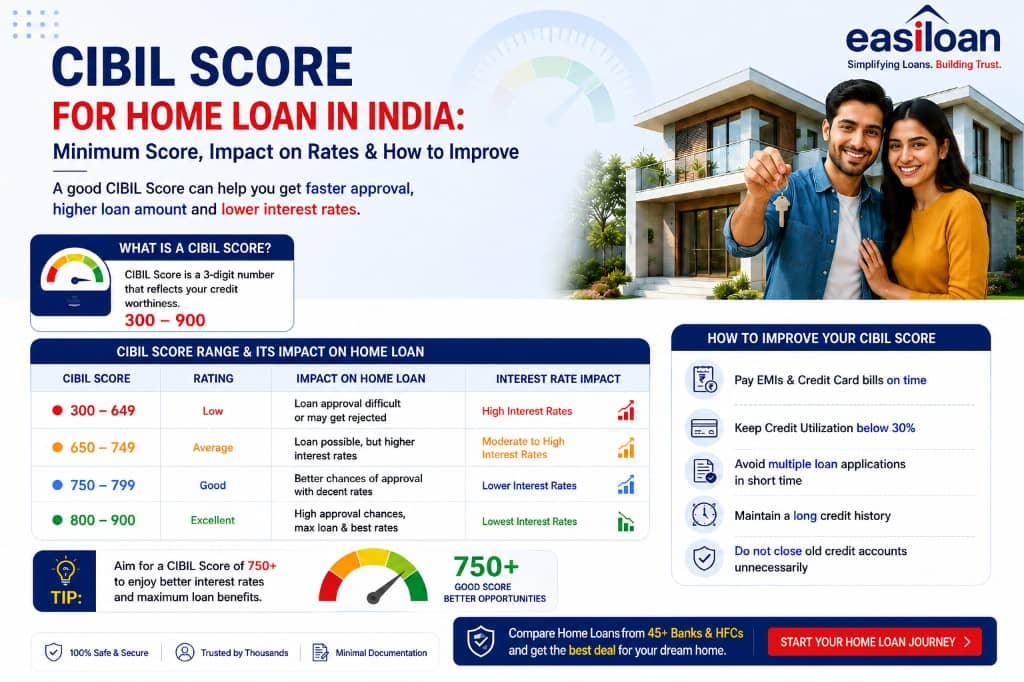
How your score affects your home loan
Drag the slider to see how your CIBIL score changes your rate and eligibility.
Good to very good
8.70% – 9.15%
Good rates from most lenders. Negotiate actively — your score gives you bargaining power. Use Easiloan to compare competing offers.
How much does CIBIL score actually affect your interest rate?
The table below shows representative rates offered by major lenders in June 2026, based on CIBIL score ranges. The rate difference is significant — and when compounded over 20–25 years, the total cost difference can be enormous.
| CIBIL Score | Category | Typical rate range | Extra cost (₹60L, 20yr) |
|---|---|---|---|
| 800 – 900 | Excellent | 8.40% – 8.70% | Baseline |
| 750 – 799 | Good | 8.70% – 9.15% | +₹1.8L – ₹3.6L |
| 700 – 749 | Fair | 9.15% – 9.75% | +₹4.2L – ₹7.5L |
| 650 – 699 | Below average | 9.75% – 10.50% | +₹8L – ₹14L |
| Below 650 | Poor | Likely declined or 11%+ | Often rejected |
What counts as a "good" CIBIL score?
For most major banks (SBI, HDFC, ICICI), 750+ is the sweet spot for the best rates. 700–749 typically gets you a standard approval but at a premium rate. Below 700, you may face rejection from PSU banks and should look at NBFCs or HFCs which have more flexible criteria.
What makes up your CIBIL score?
CIBIL scores range from 300 to 900. Here's how the score is approximately weighted:
- Payment history (35%) — the single most important factor. Even one 30-day late payment can drop your score by 50–80 points
- Credit utilisation (30%) — how much of your available credit limit you're using. Keep this below 30%
- Length of credit history (15%) — older accounts help. Don't close your oldest credit card
- Credit mix (10%) — a combination of secured (home loan, car loan) and unsecured (credit card, personal loan) credit is healthy
- New credit enquiries (10%) — each hard inquiry drops your score slightly. Avoid applying for multiple credit products at once
How to improve your CIBIL score before applying
If your score is below 750, here's a systematic plan:
Get your free CIBIL report and check for errors
Request your free annual report from cibil.com. Around 20% of reports have errors — wrong loan accounts, outdated records, or accounts that belong to someone else. Dispute errors online; corrections take 30–45 days.
Clear all overdue payments immediately
Even a single "Days Past Due" (DPD) entry will severely dent your score. Settle any outstanding EMIs, credit card minimums, or overdue accounts before doing anything else.
Reduce credit card utilisation below 30%
If your credit card limit is ₹2 lakhs and your balance is ₹1.2 lakhs (60% utilisation), request a limit increase or pay it down to below ₹60,000. This can improve your score by 20–40 points within a billing cycle.
Don't close old credit cards
Old accounts add to your credit history length and available credit. Keeping a zero-balance old card active is usually better than closing it.
Set up auto-pay for all EMIs
Going forward, never miss a payment. Set up NACH mandates for all EMI accounts. A 12-month clean payment history can raise your score by 60–100 points.
Wait 3–6 months before applying
Credit score improvements take time to reflect. Plan your application timeline accordingly — apply at least 3 months after you've made all corrections.
✓ Quick win: check before applying
Always check your CIBIL score before applying for a home loan. If it's below 750, a 3–6 month improvement plan could save you ₹4–8 lakhs over your loan tenure. It's worth the wait.
What if my score is below 650?
You're not out of options, but the path is narrower:
- NBFCs and smaller HFCs like Bajaj Housing Finance, Tata Capital, or Aadhar Housing Finance have more flexible credit policies and can approve loans at scores of 620–650
- Adding a co-applicant with a strong CIBIL score (750+) can significantly improve your application
- Larger down payment (40%+) reduces lender risk and may offset a lower score
- Wait and rebuild — a focused 6–12 month credit improvement plan is often the most cost-effective path
Frequently asked questions
Does checking my own CIBIL score damage it?
No. Checking your own score is called a "soft inquiry" and has zero impact on your credit score. Only "hard inquiries" — when a lender pulls your credit report after you apply for a loan — can temporarily lower your score.
How long does a bad credit history stay on my report?
Negative information like late payments, defaults, and settlements generally stays on your CIBIL report for 7 years. However, the impact on your score diminishes over time — a late payment from 4 years ago affects your score much less than one from 6 months ago.
I have no credit history. Can I get a home loan?
Yes, but with limitations. Some lenders — particularly PSU banks like SBI — will consider applicants with no credit history (score shown as "NH" or "NA") using alternative assessments like banking transactions and employer profile. However, you'll likely pay a slightly higher rate. Building at least a basic credit history (one credit card used responsibly for 12 months) before applying is strongly advisable.
Know your rate before you apply
Enter your details and get actual loan offers. No hard credit pull, no commitment.
See my offers →