
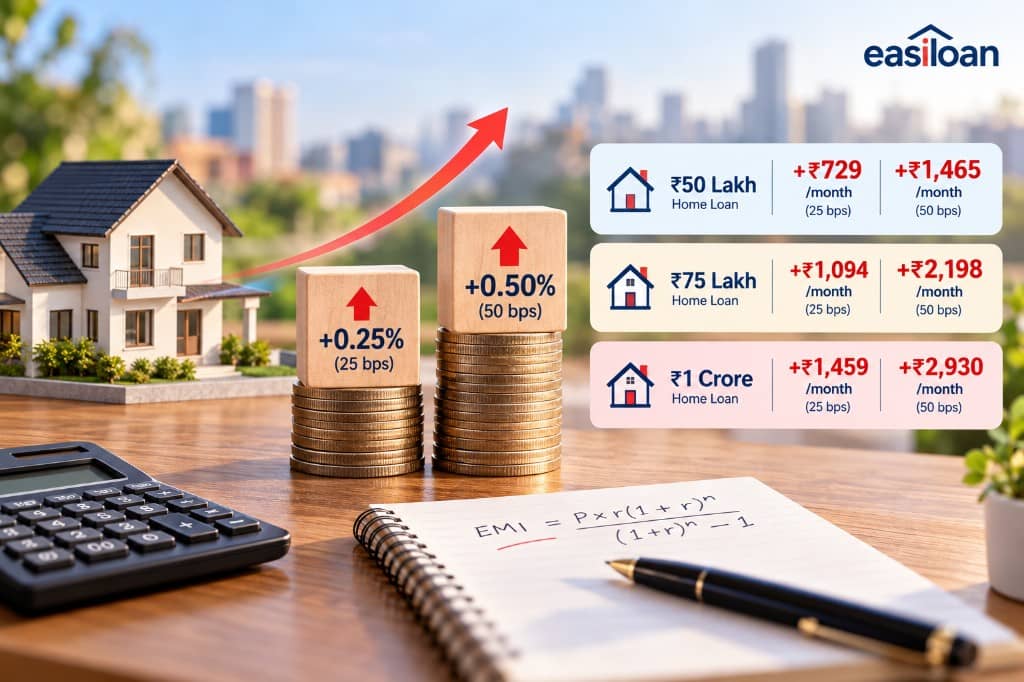
Rate-change headlines rarely tell you what a 25 or 50 basis point move actually costs in rupees. Here's the direct math, across three common loan sizes.
The mechanics, briefly
A basis point (bps) is 1/100th of a percentage point — so 25 bps equals 0.25%, and 50 bps equals 0.50%. On a floating-rate home loan, when your benchmark changes by this much, your lender typically applies the full change at your next reset, then either raises your EMI (keeping tenure the same) or extends your tenure (keeping EMI the same), depending on your lender's policy and your own instruction, where permitted.
Why it matters
The same percentage change produces very different rupee amounts depending on your loan size and remaining tenure. A borrower who only thinks in percentages can badly misjudge their actual exposure — the tables below make the real numbers explicit.
EMI impact at a glance
(Assumptions: 20-year original tenure, 15 years remaining, starting rate 8.5%, EMI recalculated to keep tenure constant.)
₹50 lakh loan, 15 years remaining
| Scenario | Rate | EMI | Change |
|---|---|---|---|
| Current | 8.50% | ₹49,237 | — |
| +25 bps | 8.75% | ₹49,966 | +₹729/month |
| +50 bps | 9.00% | ₹50,702 | +₹1,465/month |
₹75 lakh loan, 15 years remaining
| Scenario | Rate | EMI | Change |
|---|---|---|---|
| Current | 8.50% | ₹73,855 | — |
| +25 bps | 8.75% | ₹74,949 | +₹1,094/month |
| +50 bps | 9.00% | ₹76,053 | +₹2,198/month |
₹1 crore loan, 15 years remaining
| Scenario | Rate | EMI | Change |
|---|---|---|---|
| Current | 8.50% | ₹98,473 | — |
| +25 bps | 8.75% | ₹99,932 | +₹1,459/month |
| +50 bps | 9.00% | ₹1,01,403 | +₹2,930/month |
Figures are indicative, computed on standard amortisation formulas; your actual numbers will vary with your exact rate, tenure and lender's rounding conventions. Use the calculator alongside for your specific loan.
Example: total interest impact over the remaining tenure
For the ₹50 lakh example above, a sustained 50 bps increase (kept for the full 15 remaining years, EMI adjusted rather than tenure) adds roughly ₹2.6 lakh in total interest cost over that period — even though the monthly difference (₹1,465) feels modest in isolation. This is the core reason small rate moves matter more than they first appear: the effect compounds over a long remaining tenure.
With the RBI's October MPC decision due on 7 October 2026 and a 25 bps move cited as the base case in several analyst notes, these tables are directly actionable right now for anyone wanting to understand their specific exposure ahead of the announcement.
What should homebuyers do?
- Identify your own loan's outstanding principal and remaining tenure, not just your original loan amount.
- Decide in advance whether you'd prefer an EMI increase or a tenure extension if your lender gives you the choice.
- Build a small buffer into your monthly budget if you're currently near the edge of comfortable affordability.
- Don't extrapolate percentage-only headlines without running your own numbers.
- Revisit this calculation after every future MPC decision, not just this one.
Run this for your exact loan
These tables use representative figures — get your own number with the calculator.
Try the EMI CalculatorFrequently Asked Questions
What's the difference between a basis point and a percentage point?▾
100 basis points equal 1 percentage point. "25 bps" is the same as "0.25%" — the terms are used interchangeably in rate-change reporting.
Does a rate change always affect my EMI immediately?▾
No — it takes effect at your loan's next scheduled reset, which depends on whether you're on EBLR (commonly quarterly) or MCLR (often slower, sometimes annual).
Is it better to let my EMI increase or my tenure extend after a rate hike?▾
Extending tenure keeps your EMI stable but increases total interest paid over the loan's life; increasing EMI keeps the payoff timeline the same and generally costs less in total interest.
Do these calculations apply to fixed-rate loans?▾
No — a genuine fixed-rate loan is unaffected by a benchmark change during its fixed period. These tables apply specifically to floating-rate loans.
Where can I calculate this for my exact loan amount and rate?▾
Use a dedicated EMI calculator with your specific principal, remaining tenure and current rate — the tables above use representative figures.
Sources
- Standard loan amortisation methodology (reducing-balance EMI formula); figures computed for this article based on stated assumptions
- RBI MPC rate-decision context: Business Today, "Will RBI hike repo rate?," 5 October 2026
Related Reading
Information in this article reflects publicly available data and reporting as of the "as of" date stated above. Figures tied to a live or proposed RBI decision may change once a final announcement is made — always confirm the latest position with your lender. This is general information, not financial advice. EMI figures are indicative estimates. Home loan rates, spreads, fees and eligibility vary by lender and are subject to credit appraisal.