
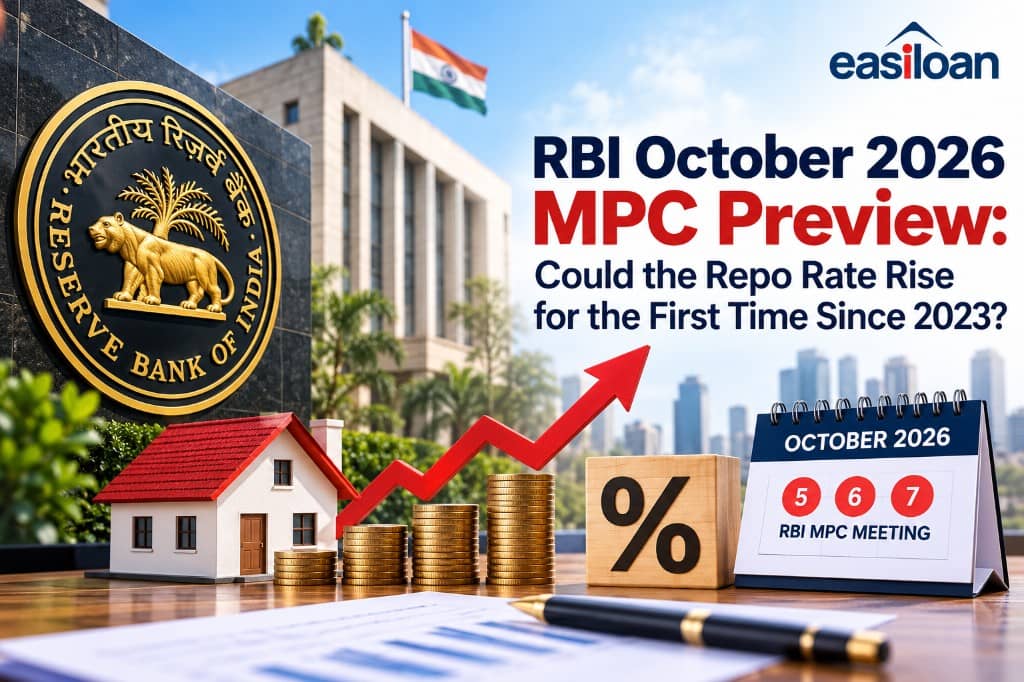
The repo rate has sat at 5.25% through four straight MPC reviews. This week's meeting is different: for the first time since February 2023, a growing number of economists expect the RBI to raise rates rather than hold or cut them.
Why this meeting is different
The Reserve Bank of India's six-member Monetary Policy Committee, chaired by Governor Sanjay Malhotra, began its three-day deliberation on 5 October 2026. The policy decision is due on 7 October at 10:00 AM IST. Everything in this article reflects market expectations, not a confirmed outcome, until that moment.
The repo rate has held at 5.25% through four consecutive reviews, including August 2026. What makes October different is that a meaningful share of analysts now expect a hike. A Reuters poll of economists points to a possible 25 basis point increase to 5.50% — which would be the first hike since February 2023. Some brokerages, including SBI Research, have floated a further 25 bps move by December, which would take the repo rate to 5.75% by year-end if both materialise. None of this is confirmed; it is the base case in several analyst notes, not a decision that has been made.
What's pushing the debate toward a hike
- Inflation running above target. August CPI inflation came in at 4.82%, up from 4.45% in July, with food inflation at 5.95% — above the RBI's 4% medium-term target for a third straight month.
- Crude oil well above the RBI's planning assumption. Brent crude has traded above $100/barrel through late September and early October, against a reported RBI planning range closer to $80-85, driven partly by tensions in West Asia. India imports over 88% of its crude needs, so sustained high oil prices widen the import bill and feed inflation directly.
- A weaker rupee. The rupee has weakened roughly 6-7% against the dollar in 2026, trading near 96, pressured by costly oil imports, a stronger dollar, and portfolio outflows.
5.25%
Current repo rate, unchanged for 4 straight reviews
4.82%
August 2026 CPI inflation (target: 4%)
~$101
Brent crude, early October 2026
Example: what a 25 bps hike would mean
On a ₹50 lakh home loan with 18 years remaining at a current rate of 8.5%, a 25 bps increase to 8.75% raises the EMI from roughly ₹44,650 to about ₹45,330 — an increase of around ₹680 a month, or over ₹1.46 lakh in additional interest across the remaining tenure if EMI is adjusted rather than tenure. On a ₹1 crore loan under the same terms, the monthly increase is roughly double, around ₹1,360. See our dedicated EMI-sensitivity breakdown for the full picture across loan sizes.
What could happen next
If the RBI hikes 25 bps, EBLR-linked floating-rate loans would reflect it within the lender's next reset cycle (commonly within a quarter), either as a higher EMI or extended tenure. If the RBI holds, this would be a fifth straight unchanged review, pushing attention to December. Either outcome — or something in between — remains genuinely open until the 7 October announcement.
What should homebuyers do?
- Don't rush or delay a decision purely because of this meeting — a 25 bps move is unlikely to change the fundamental affordability math enough to justify it on its own.
- Check whether you're on EBLR or an older benchmark — EBLR-linked loans reflect changes faster than MCLR-linked ones.
- Run the actual rupee numbers for your loan size rather than reacting to a headline percentage.
- If you're near your maximum eligibility, build in a buffer before committing to a large purchase.
- Wait for the actual announcement rather than acting on pre-decision commentary.
See your own exposure before the decision lands
Run your loan amount through the calculator to see what a 25 or 50 bps move would mean for you.
Try the EMI CalculatorQuick EMI Calculator
See how a rate change could translate into your monthly payment.
Estimated Monthly EMI
₹43,391
Frequently Asked Questions
Has the RBI already raised the repo rate in October 2026?▾
As of this writing (5 October 2026), no — the MPC meeting is in progress and the decision is due on 7 October at 10:00 AM IST. Treat any claim of a confirmed hike before that date and time as unverified.
Why would the RBI raise rates after four meetings of holding steady?▾
Primarily because inflation (4.82% in August) has moved above the RBI's 4% target for three straight months, compounded by elevated crude oil prices and rupee weakness.
Will a rate hike affect my fixed-rate home loan?▾
No — a genuine fixed-rate loan is unaffected by repo rate changes during its fixed period. Only floating-rate loans are affected, and only once their benchmark resets.
How quickly would a hike reach my EMI?▾
For EBLR-linked loans, typically within the next quarterly reset cycle. For older MCLR-linked loans, transmission can be slower and less predictable.
Is a rate hike bad for the housing market?▾
It increases borrowing costs at the margin, but a single 25 bps move is modest relative to overall affordability drivers like income growth and property prices.
Sources
- Business Today, "Will RBI hike repo rate? MPC begins 3-day meet as surging crude oil, inflation test policy limits," 5 October 2026
- Business Standard, "Weekly policy watch: RBI monetary policy, GST Council meet and PMI in focus," 5 October 2026
- Upstox, "RBI MPC October 2026: Will repo rate rise 25 bps? What borrowers and FD savers should know," 4 October 2026
- ExchangeRates.org.uk, "USD/INR Forecast: Oil Prices, Food And A Weaker Rupee Put Pressure On RBI," 4 October 2026
- Goodreturns, "RBI MPC Meeting October 2026: When Is Repo Rate Decision?," 5 October 2026
Information in this article reflects publicly available data and reporting as of the "as of" date stated above. Figures tied to a live or proposed RBI decision may change once a final announcement is made — always confirm the latest position with your lender. This is general information, not financial advice. EMI figures are indicative estimates. Home loan rates, spreads, fees and eligibility vary by lender and are subject to credit appraisal.