
India's skylines are transforming fast. Vertical living is no longer just aspirational — for millions of urban families, it's becoming the default smart choice. Here's the full picture on high-rise living in Indian cities.
7.7%
Housing price growth YoY (2026)
2nd
Hyderabad's rank for skyscrapers in India
50+
Floors in new residential towers
"For many urban families, modern apartments in Indian cities are no longer an aspirational idea — they are the default choice. High-rises use land more efficiently and allow developers to pack in amenities that individual plots can rarely match."
What's Driving the Trend
The High-Rise Housing Wave in Indian Cities
Urbanisation, Jobs & Land Pressure
Cities attract a constant stream of migrants for jobs, business and education. As land becomes scarce in central and suburban locations, developers go vertical — creating more homes on the same parcel while still offering open spaces, clubhouses and shared facilities. Hyderabad, for instance, ranks second for skyscrapers in India, with many 40–50 floor residential towers in the pipeline.
Changing Aspirations and Lifestyle
The new urban middle class doesn't just want a flat — they want safety, convenience, good design, branded amenities and a sense of community. Developers have responded with landscaped podiums, rooftop pools, co-working lounges, EV charging stations, smart home automation and concierge services. The urban high-rise lifestyle is no longer seen as a compromise.
Investment and Supply Trends
Towers near IT parks, metro lines and business districts see strong rental demand. A growing share of new launches fall in the premium and luxury brackets — which usually come in high-rise gated communities. That naturally pushes more buyers towards vertical residential formats, simply because that is where new inventory is.
Core Advantages
The Real Benefits of High-Rise Living
Location & Connectivity
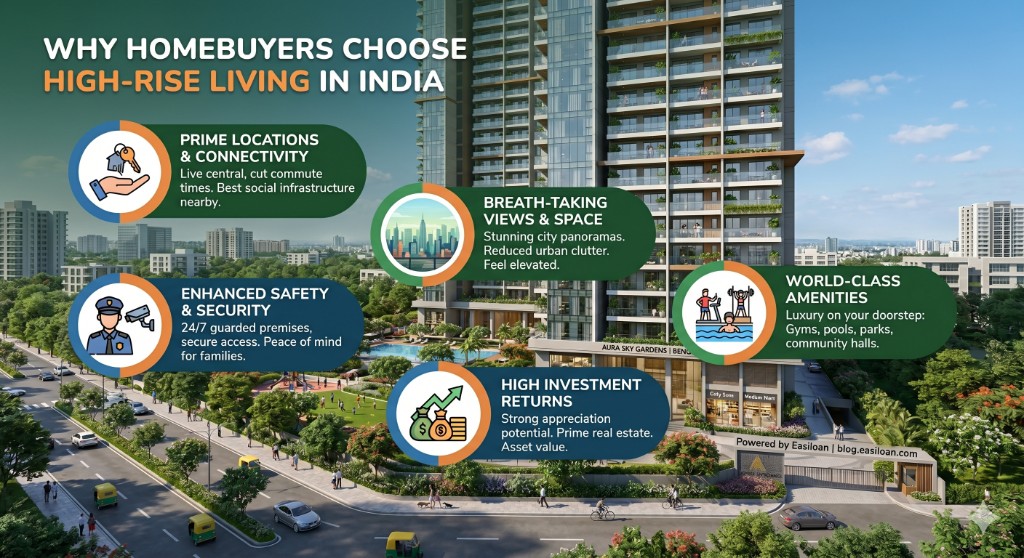
Most high-rise projects cluster near major employment hubs, metro networks and arterial roads — reducing daily commute stress and keeping you "inside the action."
All-In-One Campus Amenities
Gyms, pools, kids' zones, co-working lounges, party halls, cafes and jogging tracks — all within your compound. No separate memberships or travel needed.
24/7 Security & Access Control
Manned gates, CCTV surveillance, visitor logging and intercom-based approvals offer a level of safety hard to replicate in standalone homes.
Light, Air & Views
Higher floors mean better ventilation, more natural light, less dust, lower street noise and wider vistas — sunsets, monsoon clouds and city skylines included.
Community & Social Life
Hundreds of families sharing one campus means events, festivals, WhatsApp groups, carpools, shared tuitions and informal support networks for children and adults alike.
Appreciation & Rental Potential
Well-located towers by credible builders near strong employment hubs attract quality tenants and see steady capital appreciation over 7–10 years.
Target Profiles
Who Is High-Rise Living Really For?
Young Professionals & Nuclear Families
Looking for proximity to offices, good metro connectivity, safety for children and on-campus amenities that make weekends feel like a break — not a logistics project.
Families Upgrading from Older Housing
Moving out of congested inner-city lanes or old buildings with poor maintenance. They want lifts, clean common areas, parking and reliable utilities without daily hassle.
NRIs & Frequent Travellers
Need a lock-and-leave home with managed security, easy rental potential and a globally familiar environment — especially in metro corridors.
Seniors Who Prioritise Safety
Lifts, ramps, barrier-free design, easy delivery access and a built-in social community reduce isolation and provide peace of mind for older residents.
Honest Assessment
Trade-Offs and Challenges to Know
Higher Maintenance Charges
Landscaped gardens, pools, lifts and security systems cost money. Monthly charges in mid-to-high-end projects can run into several thousand rupees and typically rise over time. Always ask for past maintenance trends before you commit.
Dependence on Lifts and Systems
Daily life depends on elevators, backup power and water pumps. Poor maintenance means long lift queues, outages and discomfort. Always check the number of lifts per tower and the developer's track record in other projects.
Crowding in Common Areas
In high-density projects, pools and gyms can feel crowded on weekends, parking ramps can congest and noise can carry from kids' zones to lower floors. Visit the property at peak evening hours, not just mid-morning.
Emergency Preparedness
Verify fire NOC and safety certifications, stairwell width, smoke detectors and whether the RWA conducts regular mock drills. A well-managed project addresses these; a poorly managed one amplifies them.
Rules, Restrictions & Community Decisions
Common assets mean shared rules — renovation hours, pet policies, balcony use and facility timings. Some people appreciate the order; others feel constrained. Know yourself before you sign.
Decision Framework
High-Rise vs Low-Rise vs Independent House
High-Rise Apartment
Best for most urban buyers
- Strong security & amenities
- Excellent connectivity
- High rental demand
- Built-in community
- Higher maintenance charges
- More rules and restrictions
Low-Rise Apartment
Fewer amenities, simpler life
- Lower maintenance costs
- Less lift dependence
- More homely feel
- Limited amenities
- No professional facility mgmt
- Weaker rental demand
Independent House / Villa
Maximum control, high upkeep
- Land ownership
- Full privacy & control
- No shared rules
- High maintenance burden
- Self-managed security
- Often far from job hubs
Before You Sign
Practical Checklist for High-Rise Buyers
Builder Credibility & Past Projects
Check how many projects the builder has completed in your city, the condition of those projects after 5–10 years, and any reported delays or legal disputes. Always visit an older completed project in person.
RERA Registration & Legal Clarity
Verify project registration under your state's RERA, approved floor plans, land title clarity and whether the Occupancy Certificate (OC) has already been obtained for completed phases. This is non-negotiable.
Structural Design & Safety Features
Check earthquake resistance for your city's seismic zone, fire safety systems (sprinklers, hydrants, smoke detectors), staircase width and number of elevators per tower.
Density, Open Space & Tower Placement
Walk the site — check how many units share each lift lobby, how much is genuinely open green space, the distance between towers, and whether amenities are spread out or crammed into a corner.
Orientation, Floor & Flat Layout
East or north-facing units get better daylight. Check where your balconies face — road, gardens, another tower or a future construction site. Visit the sample flat at different times of day.
Maintenance Model & Society Governance
Ask for first-year maintenance charges, facility management agency details, when residents take over from the builder, and rules for pets, rentals and renovations.
Connectivity, Daily Ecosystem & Future Growth
Check current distances to workplaces, schools, hospitals and supermarkets — plus announced metro lines, flyovers or IT parks nearby. A project at the intersection of good connectivity and promising infrastructure delivers the strongest returns.
How to Make High-Rise Living Work for You
Five practical steps before you sign on a high-rise home loan.
Choose a credible developer with a track record of delivering on time and maintaining quality over years.
Budget for maintenance and community rules — factor in monthly charges when calculating your total cost of ownership.
Select the right location, tower, floor and layout for your specific family, work and lifestyle needs.
Think long-term about neighbourhood evolution — upcoming infrastructure, changing job corridors and future development will affect both liveability and value.
Ensure legal clarity before you commit — RERA registration, OC status and land title are non-negotiable checkboxes.
Frequently Asked Questions
Why are high-rise apartments becoming popular in India?▾
Urban land scarcity, rising incomes and changing lifestyle expectations are all driving the trend. High-rises allow developers to create more homes on limited land while delivering amenities that low-rise or independent properties rarely can. Cities like Mumbai, Bengaluru and Hyderabad are seeing this shift most acutely.
What are the key benefits of living in a high-rise?▾
Better connectivity, 24/7 security, on-campus amenities (gyms, pools, co-working spaces), natural light and views on higher floors, built-in community life, professional facility management, and often stronger rental and appreciation potential in well-located micro-markets.
Are high-rise apartments more expensive than low-rise buildings?▾
Generally yes, both in purchase price and in monthly maintenance. However, the higher price often reflects location quality, amenities and long-term demand. The right high-rise in a strong corridor can deliver better returns than a cheaper low-rise that's poorly located.
Do high-rise buildings offer better safety?▾
Yes, in most cases. Reputed projects come with 24/7 manned security, CCTV, visitor management and access control. Higher floors also reduce easy intrusion from street level. Modern buildings follow updated structural and fire safety codes — though it's important to verify certifications before buying.
Which Indian cities have the most high-rise residential projects?▾
Mumbai leads in overall skyscrapers. Hyderabad is second and growing rapidly, with several 40–50 floor towers. Bengaluru, Gurugram, Pune, Chennai and Ahmedabad are also seeing significant high-rise development — particularly in premium and luxury project segments.
Ready to buy your home in a high-rise?
Check your home loan eligibility in minutes — no impact on your credit score.
Check eligibility