
Real Estate Investment · 2026
India's infra budget allocation 2026
Typical price appreciation near metro stations
Delhi-Mumbai Expressway — India's longest
Lenders compared on EasiLoan platform
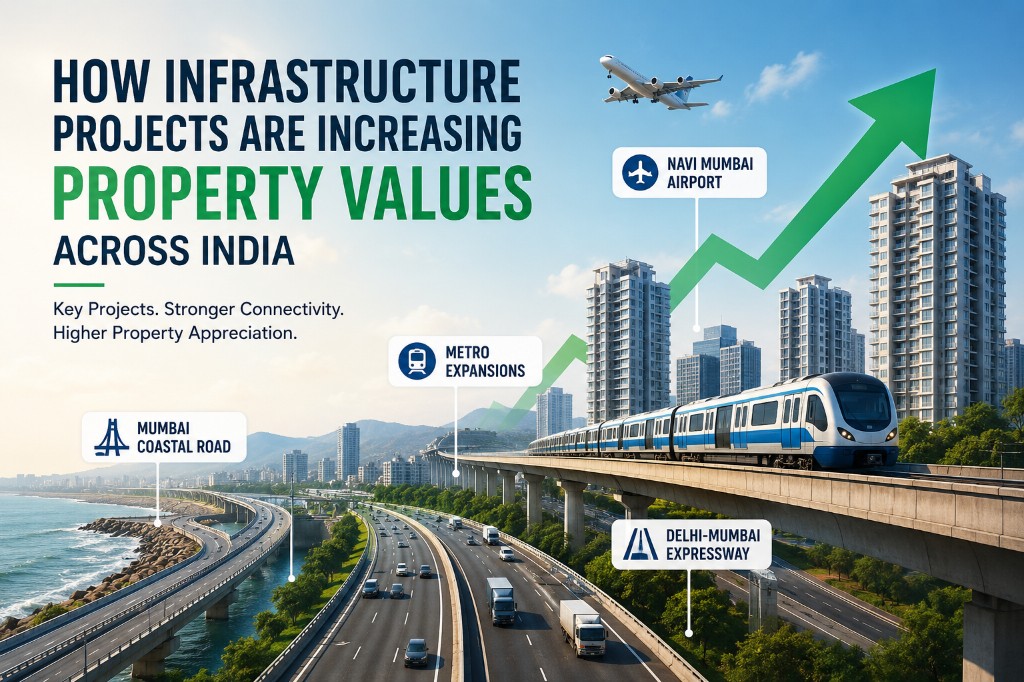
Infrastructure development has become the single most reliable predictor of real estate growth in India. Where roads, metros, airports, and expressways go — property prices follow. In 2026, several landmark projects are in advanced stages of completion, creating a narrow but powerful window for buyers and investors to enter before appreciation peaks.
The Foundation
Why Infrastructure Development Drives Property Values
Better Connectivity
Metro, roads, and expressways shrink commute times and expand the liveable radius of major cities.
Job Creation
Large projects generate employment, attracting a working population that needs housing nearby.
Business Attraction
Improved accessibility draws commercial investment, retail, and IT parks to previously overlooked areas.
Capital Appreciation
Demand outpaces supply in newly connected areas, pushing residential prices upward over time.
Quality of Life
Smart infrastructure — green spaces, water management, digital networks — makes locations more desirable.
Rental Yield Growth
Connectivity improvements raise rental demand from professionals, boosting yields for investors.
Key Projects in 2026
5 Infrastructure Projects Reshaping Indian Real Estate
Metro networks are the most consistent driver of residential price appreciation in Indian cities. Areas once considered peripheral due to poor connectivity now command premium prices as metro corridors extend outward — transforming commute times from 90 minutes to under 30.
Impact on Property
- 20–40% price appreciation in areas gaining metro access
- Higher rental yields from working professionals
- Faster resale liquidity compared to non-metro localities
- Increased demand for 1BHK and 2BHK configurations
Investor Strategy
- Buy within 500m–1km of upcoming metro stations
- Enter before project completion for maximum upside
- Look for under-construction projects near confirmed station sites
- Check interchange stations — they generate the highest demand
Expert Insight: Property prices near metro stations tend to rise most sharply in the 12–18 months before a line becomes operational — making early entry the highest-return window for buyers.
Mumbai Coastal Road: Transforming Mumbai's Real Estate Landscape
South Mumbai · Western Suburbs · Marine Drive Corridor
The Mumbai Coastal Road dramatically improves north-south connectivity between South Mumbai and the western suburbs, bypassing some of the most congested stretches in the city. For homebuyers, this means that previously time-poor locations are now viable for daily commuting — unlocking value in areas that were ignored purely due to traffic.
Connectivity Benefits
- Significant reduction in South Mumbai to Bandra travel time
- Direct access to key business and commercial hubs
- Reduced dependence on congested arterial roads
- Improved emergency and logistics infrastructure
Real Estate Impact
- Increased buyer interest in western suburb properties
- Commercial office demand rising along the corridor
- Premium for sea-facing units further strengthened
- Long-term rental demand boost from relocated professionals
Navi Mumbai International Airport: India's Biggest Growth Catalyst
Navi Mumbai · Panvel · Ulwe · Kharghar · Dronagiri
The Navi Mumbai International Airport is shaping up to be one of the most significant real estate catalysts of this decade. Airports function as engines of economic growth — creating jobs, attracting logistics and hospitality businesses, and triggering demand for housing across a broad radius. Investors who moved early into this corridor have already seen meaningful appreciation; the window for pre-completion entry is narrowing fast.
High-Potential Localities
Why Values Are Rising
- Large-scale employment from airport operations and ancillary industries
- New commercial, retail, and hospitality development planned
- Trans Harbour Link improving overall regional connectivity
- CIDCO-developed nodes providing organised housing supply
Buyer Opportunity
- Affordable entry points compared to Thane and Mumbai suburbs
- Well-planned road and green infrastructure in CIDCO zones
- High rental demand expected from airport and logistics workforce
- Strong long-term capital appreciation potential over 5–10 years
Market Signal: Localities around the Navi Mumbai Airport have already seen notable investor activity. Buying after the airport opens typically means entering at significantly higher price points.
At 1,386 km, the Delhi-Mumbai Expressway is India's longest — and its economic footprint extends far beyond transportation. By cutting Delhi-Mumbai travel time from 24 hours to roughly 12, it is unlocking industrial and residential growth across six states and dozens of towns that were previously outside viable investment radius.
Economic Impact
- Reduced logistics costs attracting warehousing and manufacturing
- Industrial clusters forming near key junction towns
- New employment hubs emerging along the entire corridor
- Boost to agricultural and MSME supply chain efficiency
Real Estate Opportunity
- Residential demand rising in towns near expressway interchanges
- Affordable land prices still available in Tier 2 corridor towns
- Commercial and warehousing real estate seeing early investor interest
- Long-term appreciation driven by industrial growth, not speculation
Smart Cities Mission: Urban Upgrades Supporting Long-Term Growth
100 Cities Across India · Digital Infrastructure · Civic Upgrades
India's Smart Cities Mission is improving urban liveability across 100 cities through investments in digital infrastructure, water management, public transport, green spaces, and civic amenities. While less headline-grabbing than a new airport, these foundational upgrades make cities significantly more attractive to residents and investors — and their impact on property values compounds over time.
Key Improvements
- High-speed public Wi-Fi and digital governance services
- Integrated command and control centres for urban management
- Upgraded water supply and sewage management systems
- New public parks, pedestrian zones, and cycling infrastructure
Real Estate Effect
- Improved civic amenities raise neighbourhood desirability
- Attracts remote workers seeking high-quality Tier 2 locations
- Steady appreciation without speculative volatility
- Better resale liquidity in cities with strong Smart City progress
How to Evaluate a Property in an Infrastructure Corridor
Before committing to a purchase near any infrastructure project, verify these factors
Confirm distance from the infrastructure project and planned completion timeline
Verify builder credentials, RERA registration, and project approvals
Research future development master plans for the micro-market
Check connectivity to existing business districts, schools, and hospitals
Assess current and projected rental demand in the locality
Compare recent transaction prices to identify early vs. late entry pricing
Evaluate social infrastructure: retail, healthcare, education within 3 km
Compare home loan offers from multiple lenders before finalising purchase
Choosing the Right Home Loan for Infrastructure-Led Investment
Identifying the right location is only half the equation. The home loan you choose directly affects your monthly cash flow, total cost of ownership, and investment returns. Even a 0.25% difference in interest rate translates to lakhs of rupees over a 20-year tenure.
When evaluating home loans for a property in an emerging corridor, compare across these five dimensions:
Interest Rates
Processing Fees
Tenure Options
EMI Affordability
Prepayment Terms
Disbursal Speed
EasiLoan lets you compare all of these factors across 40+ banks and HFCs from a single platform — so you can make a data-driven decision rather than settling for the first offer you receive.
Common Questions
Frequently Asked Questions
How do infrastructure projects increase property values in India?▾
Infrastructure projects reduce commute time, create employment, and attract businesses — all of which drive housing demand upward. As demand increases faster than supply in newly accessible areas, property prices rise. Buyers who enter before a project's completion typically benefit from the steepest appreciation curve.
Which areas near Navi Mumbai Airport will see the highest property appreciation?▾
Ulwe, Panvel, Kharghar, Dronagiri, Taloja, and Kamothe are the localities most directly impacted by the Navi Mumbai International Airport. These areas offer lower entry prices compared to central Mumbai, with strong long-term appreciation potential as the airport and supporting infrastructure become operational.
Should I buy near a metro station in 2026?▾
Yes — with a timing caveat. The highest appreciation windows are typically 1–3 years before a metro line opens and immediately post-opening. In 2026, lines under construction in Mumbai, Delhi NCR, Bengaluru, Pune, Hyderabad, and Chennai present compelling entry opportunities. Look for properties within 500m–1km of confirmed station locations.
How does the Delhi-Mumbai Expressway affect real estate prices?▾
The expressway is drawing industrial investment and warehousing operations to junction towns along the 1,386 km corridor. This creates employment and housing demand in towns that were previously overlooked. Early-stage land and residential investments in towns near key interchanges offer substantial long-term upside at still-affordable price points.
How can EasiLoan help me get a home loan for a property in an infrastructure corridor?▾
EasiLoan lets you compare home loan offers from 40+ banks and HFCs on a single platform. You can check your eligibility, review interest rates and processing fees side by side, upload documentation digitally, and track your application — without visiting multiple bank branches. This is particularly useful when purchasing in emerging corridors where timely loan processing can be critical.
The 2026 Infrastructure Opportunity: Act Before the Window Closes
The relationship between infrastructure and property values is well-established — but the returns belong to buyers who enter early. Projects like the Navi Mumbai Airport, metro expansions, the Delhi-Mumbai Expressway, and Smart City upgrades are not speculative bets: they are funded, under construction, and approaching completion.
In 2026, the question for serious homebuyers and investors isn't whether these projects will create value — it's whether they enter before or after the steepest appreciation has already occurred. The corridors with the strongest fundamentals remain accessible, but that window is closing as projects near their operational dates.
Combine location intelligence with the right home loan, and infrastructure-led real estate investment becomes one of the most reliable wealth-building strategies available to Indian buyers today.
Disclaimer: Property appreciation figures and interest rates mentioned are indicative only. Real estate investments are subject to market risks. EasiLoan is not a lending institution or investment advisor. Please conduct independent due diligence before making any property or financial decision.
Easiloan · Home Loan Platform
Ready to Invest in India's Infrastructure Growth Story?
Compare home loans from 40+ banks and HFCs, get expert advisory, and secure the right financing for your property — all from a single platform.