
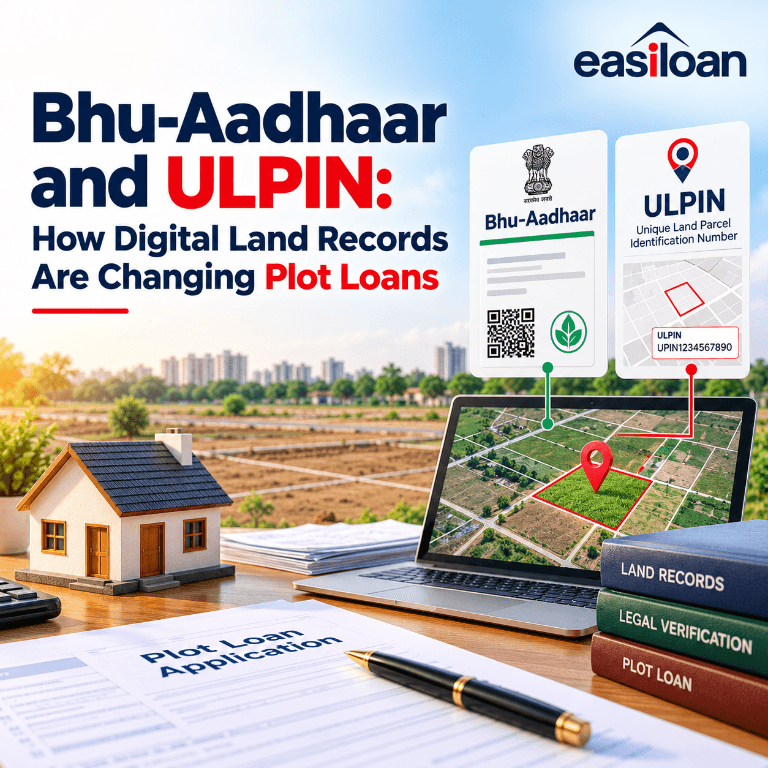
A government briefing on 27 August 2026 put numbers on India’s land-records digitisation: more than 40.58 crore land parcels carry a unique ID, and records for most of the country are computerised. For anyone buying a plot or applying for a plot loan, this changes how verification works.
What the update says
- More than 40.58 crore parcels have a 14-character alphanumeric Unique Land Parcel Identification Number (ULPIN, also called Bhu-Aadhaar).
- Records of Rights are 99.90% computerised and 76.16% georeferenced.
- 19 states allow records to be downloaded online.
- Banks in 406 districts can verify mortgage details online.
- About 94.11% of revenue-court data is computerised.
- The DILRMP 3.0 guidelines of 10 September 2026 allot ₹565.50 crore for 2026–31.
How this helps a plot buyer
A ULPIN identifies the parcel, so the same plot is less likely to be confused with another through spelling, survey-number or boundary differences. Online records and mortgage verification can also shorten the time spent checking whether a plot is already pledged.
What ULPIN does not do
Plot loan checklist
- Verify the seller's title chain for at least the period your lender requires.
- Get an encumbrance certificate and check for any existing mortgage.
- Confirm land use (residential, agricultural or commercial) and approval from the local authority.
- Match survey number and ULPIN, where available, with the sale deed and records.
- Compare the plot loan terms: lenders generally finance a lower share of the value for plots than for homes, and interest rates can be higher. If you plan to construct, ask about a combined plot-plus-construction loan.
Illustration: a ₹30 lakh plot loan over 15 years at 9.5% would have an EMI of about ₹31,327. Rates vary by lender and profile, so this is only a scale check.
A lender still needs the full legal file
Digital records make the front-end verification faster, but banks do not lend on a parcel ID alone. A lender will still review title documents, mortgage-related records, project approvals, and the actual land-use classification before sanctioning the loan. That is why ULPIN is useful as a signal of accuracy, not a substitute for legal due diligence.
Bottom line
ULPIN and Bhu-Aadhaar are a welcome step toward better land-record accuracy in India, especially for plot buyers and lenders. But the core rule remains unchanged: for a plot loan, the legal title and encumbrance history matter as much as the parcel ID. Use digital records to speed up checks, not to skip them.
Sources
- Department of Land Resources (DoLR) briefing, 27 August 2026
- DILRMP 3.0 guidelines, 10 September 2026
- Press coverage of ULPIN rollout in 29 states/UTs
This article is for general information only and is not financial, legal or tax advice. Figures are as reported on the date of publication and may change; EMI examples are illustrative, not offers. Please confirm current rates, charges and eligibility with the lender before deciding.
Check your plot loan readiness with Easiloan
Compare lenders and understand eligibility before you buy land.
Check eligibilityFrequently Asked Questions
What is a ULPIN?
A 14-character alphanumeric ID assigned to a land parcel, also called Bhu-Aadhaar.
Does ULPIN prove I own a plot?
No. It identifies the parcel, not the owner; title still has to be verified through documents.
Can banks check land records online?
The government says banks in 406 districts can verify mortgage details online.
Is a plot loan the same as a home loan?
No. Plot loans typically have different eligibility, loan-to-value and pricing, and the tax benefits of a home loan do not automatically apply.