
● 2026 Geopolitics & Home Finance Guide
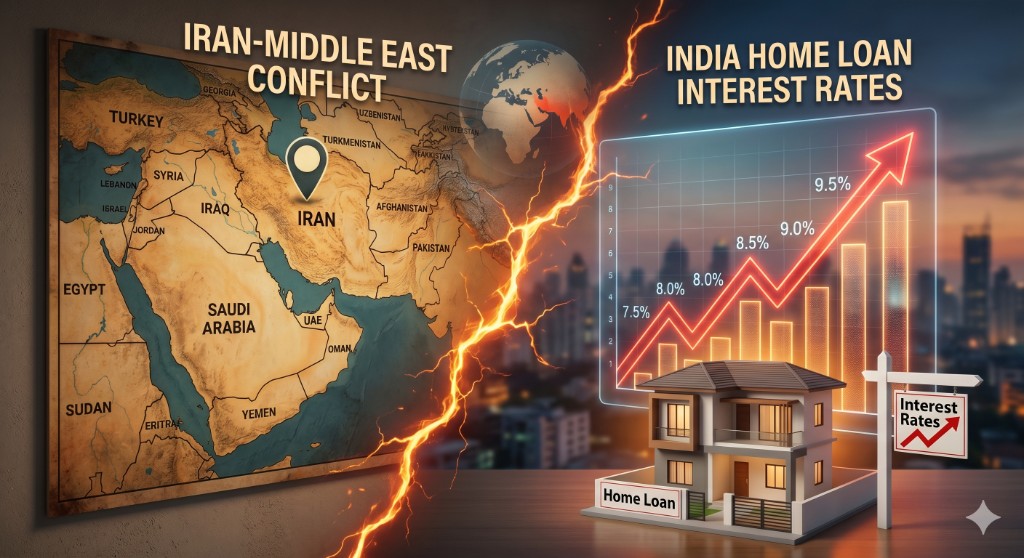
Events unfolding thousands of kilometres away in the Middle East can ripple through to your monthly EMI statement. Here's a clear, jargon-free explanation of how — and what you can do about it.
Why Does the Middle East Matter to India?
India imports nearly 85% of its crude oil requirements, with a significant share originating from the Middle East. When geopolitical tensions flare in the region — whether through trade route disruptions, sanctions, or open conflict — global oil markets react with price spikes driven by supply uncertainty.
That oil price movement doesn't stay in the commodities market. It travels through transportation, manufacturing, consumer goods, and eventually the Reserve Bank of India's policy room — touching your home loan rate along the way.
The Transmission Chain: Oil to EMI
Understanding this cause-and-effect chain helps you anticipate rather than react to rate changes.
Middle East Tensions Escalate
Supply routes are threatened; oil-producing nations restrict exports or markets price in disruption risk.
Global Crude Oil Prices Rise
Brent crude and WTI benchmarks climb. India, importing ~85% of its oil needs, pays more in dollar terms.
Fuel & Transport Costs Increase
Higher fuel prices push up freight, logistics, and manufacturing input costs across every sector.
Broad-Based Inflation Rises
Businesses pass costs to consumers. CPI and WPI indices climb. Purchasing power erodes.
RBI Responds to Inflation
The RBI delays rate cuts, holds rates longer, or raises the repo rate to anchor inflation expectations.
Home Loan Rates Stay Higher
Banks re-price EBLR-linked loans upward. Floating-rate EMIs rise. New borrowers face tighter eligibility.
How the RBI Responds to Oil-Driven Inflation
The Reserve Bank of India uses the repo rate as its primary lever for managing inflation. When oil-linked inflation is elevated and persistent, the MPC typically takes one or more of the following steps:
- Delays repo rate cuts — any anticipated relief for borrowers is pushed back
- Holds existing rates longer — the "higher for longer" scenario that extends the cost burden
- Raises rates — only in extreme inflation scenarios, but it adds to EMI pressure
Since banks price home loans off the RBI's repo rate (under the EBLR framework), any upward movement — or even a prolonged pause — directly extends the period of elevated EMIs for floating-rate borrowers.
If you want to test rate-shock scenarios on your own budget, run the numbers through our EMI calculator before you lock a lender or choose between fixed and floating options.
Fixed vs. Floating Rate Loans During Geopolitical Uncertainty
The choice between fixed and floating rate loans becomes especially significant when global volatility is a factor. Here's how they compare:
Advantages
- EMI stays constant regardless of market shifts
- Full protection from future rate hikes
- Easier to plan household budgets
Disadvantages
- Starting rate usually slightly higher
- You don't benefit if rates fall significantly
Advantages
- EMI falls when RBI cuts rates
- Generally lower starting rates
Disadvantages
- EMIs can rise during geopolitical uncertainty
- Monthly repayment is harder to predict
- Loan tenure may extend without warning
EasiLoan guidance: If you expect prolonged global volatility and value cash flow certainty, a fixed-rate period (even a 3–5 year lock-in) can be a sensible hedge. If you believe the rate cycle will ease within 12–18 months, floating may still reward you. Our advisors can model both scenarios for your specific loan amount.
Should Homebuyers Delay Their Purchase?
This is the most common question we get during periods of global uncertainty. The short answer: time the market on the basis of your finances, not geopolitics.
✅ Buy Now If…
- Your income is stable and well-documented
- You've found a property at a fair valuation
- You qualify for competitive loan rates today
- Your down payment is fully ready
- Your credit score is above 750
⏳ Consider Waiting If…
- Your income or job situation is uncertain
- Property prices in your target area look inflated
- You expect a significant income change soon
- Your emergency fund is depleted
Geopolitical events create short-term volatility, but India's long-term housing demand is structurally driven by urbanisation, a growing middle class, and government schemes like PMAY. Waiting for global calm that may never fully arrive can mean missing years of potential home value appreciation.
What Existing Borrowers Can Do Right Now
If you already have a home loan, geopolitical-driven rate pressure is manageable with proactive steps.
Review Your Loan Type
Know whether you're on a fixed, floating, or hybrid rate. Floating borrowers should model how a 0.5–1% rate increase changes their EMI before it happens.
Make Part-Prepayments
Channelling bonuses or surplus savings into part-prepayments reduces the outstanding principal — blunting the impact of any future rate increase.
Increase EMI Voluntarily
Even a small voluntary EMI top-up (5–10%) compresses the loan tenure meaningfully and reduces your total interest exposure.
Protect Your Credit Score
A strong CIBIL score (750+) keeps refinancing options open. Pay all EMIs and credit card dues on time, every month.
EMI Impact Estimator
Model how a rate hike could affect your monthly repayment before it happens.
Current monthly EMI
₹43,391
based on inputs above
If rates rise
₹44,986
Extra/month
+₹1,595
Extra/year
+₹19,142
India's Housing Market Remains Resilient
Despite the noise of global events, India's residential property market is underpinned by powerful structural forces that short-term shocks cannot easily override.
These demand drivers ensure that geopolitical volatility, while affecting the cost of borrowing in the near term, does not fundamentally alter the case for homeownership in India over a 5–10 year horizon.
Key Takeaways
Middle East tensions push global crude oil prices higher, impacting India heavily as an 85% oil importer
Higher oil prices raise transportation and goods costs, feeding broad-based inflation
Persistent inflation may cause the RBI to delay rate cuts or hold rates higher for longer
Floating-rate borrowers could see EMI increases or tenure extensions
Fixed-rate loans offer EMI stability — worth evaluating during uncertain periods
Existing borrowers can cushion the impact through part-prepayments and voluntary EMI increases
Personal financial readiness should drive home-buying decisions more than short-term geopolitical events
About EasiLoan
EasiLoan helps homebuyers compare loan offers from India's leading banks and NBFCs through a seamless digital platform — from application to disbursement. We bring transparency and speed to what has traditionally been a complex process.
Explore Home Loan OptionsRelated Guides
Get Your Best Rate Today
Compare offers from 25+ banks & NBFCs. Our advisors help you lock in the right rate before geopolitical uncertainty pushes costs higher.
Check My Eligibility →