
Looking to apply soon? Compare lenders after checking your loan amount eligibility to make a confident choice.
Clearing your last EMI is a milestone, but it is not the actual end of your home loan journey. The NOC (No Objection Certificate) is the document that officially severs every legal tie your lender has to your property.
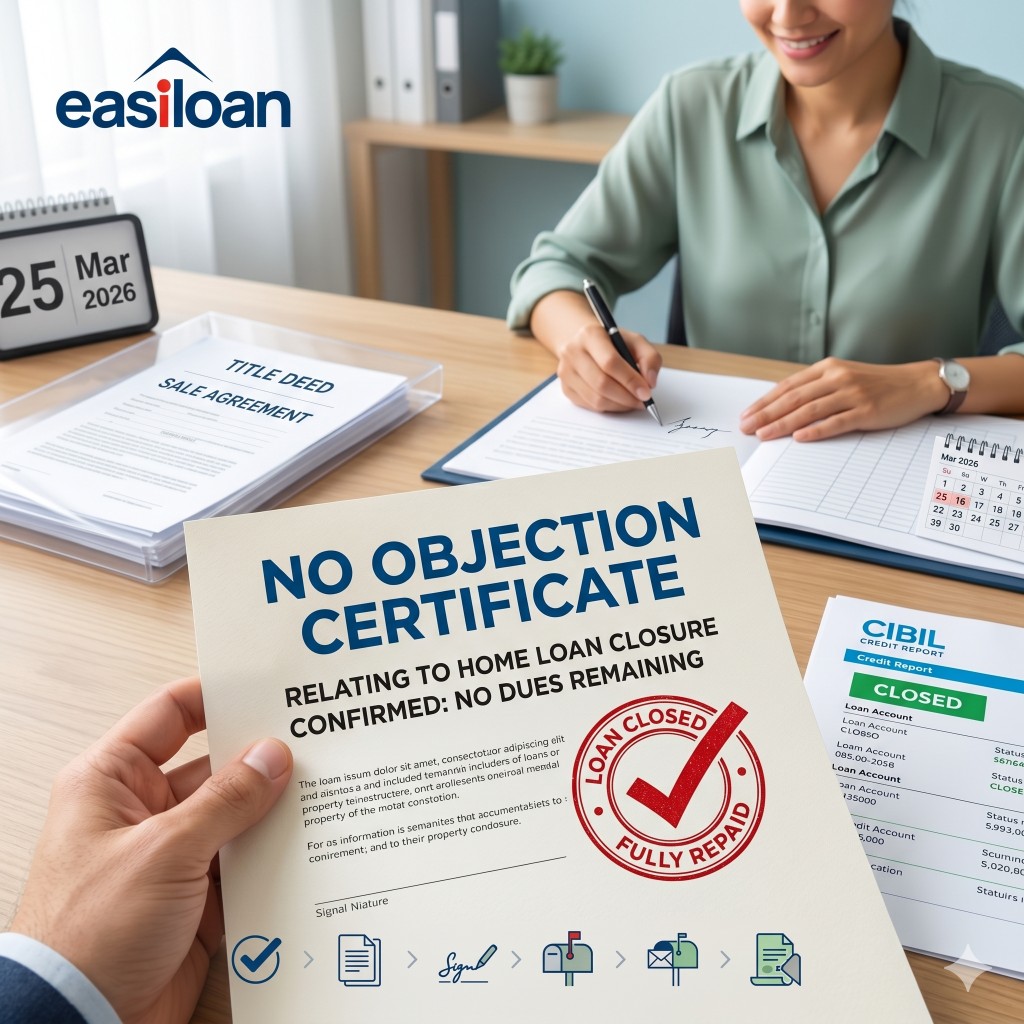
What Exactly Is a Home Loan NOC?
A home loan NOC, also called a No Dues Certificate, is issued by your bank or housing finance company once you repay the full loan. It formally states that no dues remain and the lender has no legal claim over the mortgaged property.
What it contains
Your name, property address, loan account number, closure date, no-dues confirmation, and confirmation that lender charge/lien has been lifted.
Since your home remains collateral during tenure, lender linkage stays in records until NOC-based release is completed.
Why Skipping Your NOC Can Cost You Later
🏠
Proof of Full Repayment
Confirms your loan is fully closed and nothing is outstanding.
🔓
Removes the Lender's Lien
Ends lender rights over your property in practice and records.
📄
Recover Original Documents
Supports return of title deed and related original property papers.
📊
Updates Your Credit Report
Helps ensure account status moves to Closed at bureaus.
⚖️
Protects Future Resale
Avoids legal friction during sale/transfer due to active lender charge.
🏦
Enables Future Loans
Makes balance transfer/new borrowing easier with clean closure proof.
The 8-Step Process to Get Your NOC
1) Confirm full outstanding is zero
Verify principal, interest, late charges, foreclosure/prepayment penalty, and admin fees are all settled.
2) Secure all payment proofs
Keep final payment receipts, bank transfer records, and closure acknowledgement safely.
3) Contact lender and confirm process
Some lenders auto-dispatch NOC; others need branch/app/email request initiation.
4) Submit formal NOC request
- Loan account number
- Borrower name as per loan papers
- Registered mobile and email
- Property address
- Identity proof (if asked)
- Closure/payment proof
If your address changed since sanction, update it first to avoid wrong physical dispatch.
5) Collect original property documents
Retrieve title deed, sale agreement, occupancy certificate, and all deposited originals.
6) Review NOC details carefully
- Full name
- Loan account number
- Correct property address and pin code
- Closure date
- Explicit no-dues confirmation
- Explicit no-claim statement by lender
7) Remove lender charge from records
Complete required updates at sub-registrar, housing society, development authority, or builder.
8) Check CIBIL/credit report in 4-6 weeks
Ensure status reflects Closed; if still Active, raise lender rectification with NOC copy.
Builder NOC vs Lender NOC: What's the Difference?
Borrowers often confuse these. They are different documents used at different stages.
After loan closure
Lender NOC
Issued by bank/NBFC after full repayment; confirms zero dues and release of lender claim.
During loan processing
Builder NOC
Issued by developer for under-construction purchase; confirms allotment and builder consent for financing.
In short: builder NOC is usually a start-stage document; lender NOC is a closure-stage document.
Mistakes Borrowers Make After Loan Closure
⏳
Assuming NOC arrives automatically
Proactively follow up instead of waiting indefinitely.
📁
Forgetting to reclaim original documents
Collect all papers deposited at sanction while collecting NOC.
🔗
Not removing lien from records
NOC without record updates can still create resale/legal friction.
📋
Not reviewing NOC for errors
Wrong spelling/address/account data can cause legal trouble later.
📊
Not checking bureau status post-closure
Active status after closure can impact credit profile for future loans.
Ready to Take the Next Step?
Whether you are closing an existing loan or planning a fresh home purchase, documentation quality matters. Easiloan helps you navigate every stage, from eligibility to closure.
Check Your EligibilityNeed Loan Clarity?
Check estimated eligibility and compare offers before you apply.
In This Guide
Related Guides
What Are Secured Loans and How Do They Work?
11 May 2026
Commercial Real Estate Financing in India: A Practical Guide
11 May 2026
Risks of Taking a Loan Against Stocks
7 May 2026